Bridging the gap for effective asset transparency: Analysing land registers and beneficial ownership data for legal vehicles
Registers of beneficial ownership of land
Scottish Register of Persons Holding a Controlled Interest in Land
The RCI, introduced in 2022 and maintained by Registers of Scotland (RoS), shows who controls the decisions of owners or tenants of land and property in Scotland, particularly where this information is not available in Scotland’s land registers. [27] The register requires recorded persons – legal owners or registered tenants – to disclose additional parties with a relevant controlling interest (referred to as associates). The register is freely searchable online, and provides structured records linking land to both those legally responsible for it and any declared controllers. [28] Its stated objective is to “improve transparency about those who ultimately make decisions about the management or use of land, even if they are not necessarily registered as the owner”. [29]
The RCI operates alongside two long-standing land registration systems, also maintained by RoS: the Land Register of Scotland, which records the legal proprietor of each title, and the General Register of Sasines, a deeds-based system still covering residual property titles. [30] While legally authoritative, ownership information in the Land Register is accessible only through paid, title-by-title searches, and no public bulk or machine-readable ownership dataset is available.
The RCI captures both direct and indirect interests through two distinct types of links:
- Legal relationships between the recorded person and the land, reflecting ownership or tenancy, either directly (e.g. an individual owner or tenant) or through a role within a legal arrangement without separate legal personality (e.g. a trustee of a trust, or a partner in a partnership).
- Controlled-interest relationships between the recorded person and one or more associates, representing influence or control over decisions relating to the land, rather than ownership or financial interests.
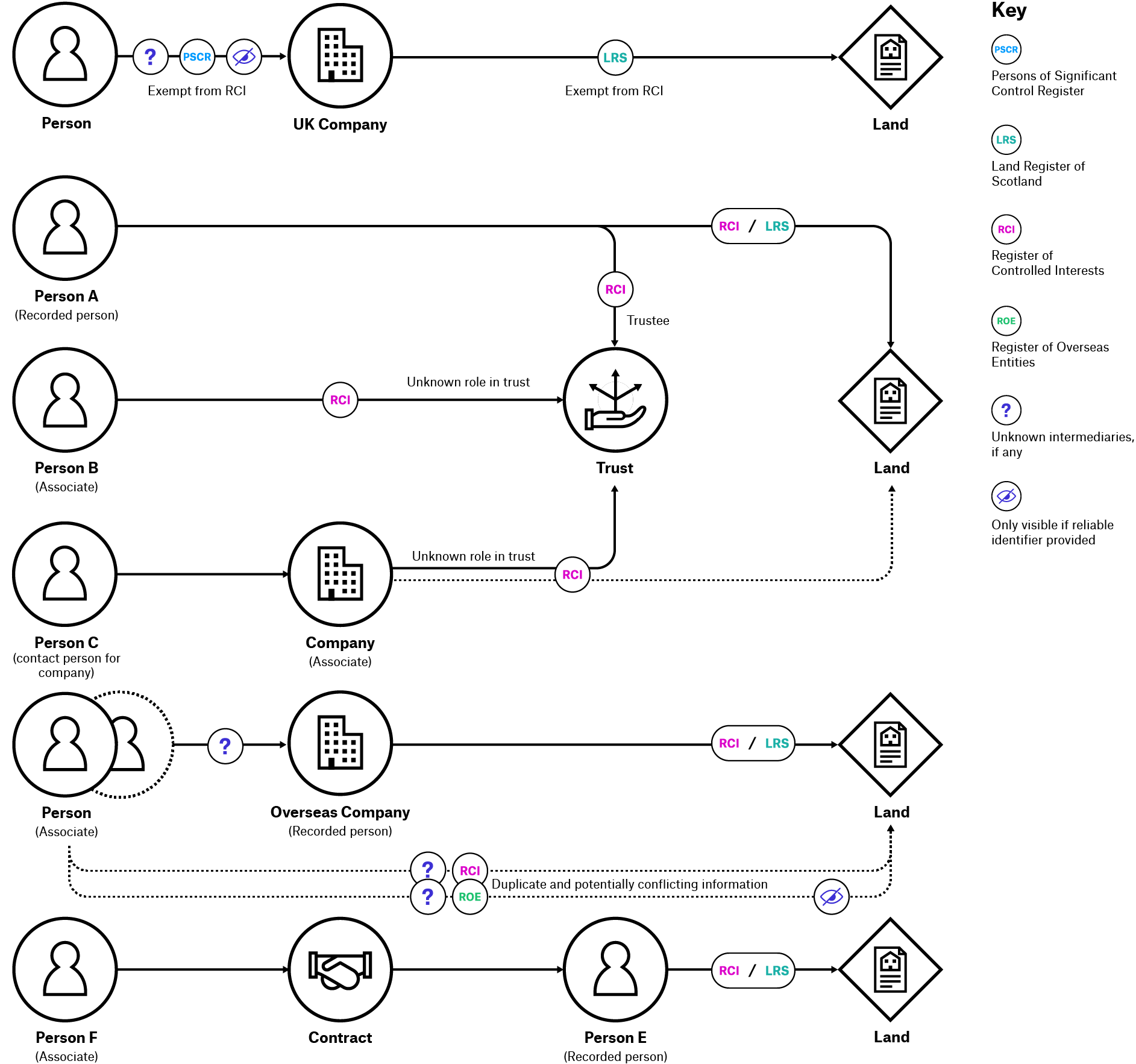
Where a recorded person (i.e. a legal owner or registered tenant) is subject to another statutory transparency regime, such as an obligation to disclose BO information to the UK’s PSC register, it is exempt from filing an entry in the RCI. If, however, an associate is covered by another transparency regime but the recorded person is not, the recorded person must still submit an RCI entry, including details of the regime under which the associate is already disclosed. The list of recognised transparency regimes is set out in secondary legislation and does not include overseas entities required to disclose BO information to the ROE. [31]
Data model
The RCI is structured around three core schema objects:
- Land: an immovable property identified by a title number and address.
- Recorded person: an individual or organisation that is the legal owner or registered tenant of the land.
- Associate: a person or organisation that holds a controlled interest in relation to the recorded person – that is, someone who exercises significant influence or control over the recorded person’s dealings with the land, without being the legal owner or tenant.
The register therefore establishes a structured link between the land, the person legally responsible for it, and any parties ultimately exercising control over the land. This data model is summarised in Table 4.
Table 4. Data model of the Scottish Register of Persons Holding a Controlled Interest in Land
| Schema object | Recorded information |
|---|---|
| Land |
Title number Land address |
| Recorded person (natural or legal person) |
Recorded person name Recorded person reference number (RCI-assigned identifier) Registered company number (if legal entity) Registered address |
| Controlled interest |
Owner or long-term lease Role or capacity (e.g. partner, trustee) Category (e.g. partnership, trust, overseas entity) Organisation name (if applicable, e.g. trust or partnership name) |
| Associate (natural or legal person) |
Associate name Registered company number (if legal entity) Contactable details (address) Associate reference number (RCI-assigned identifier) Transparency regime (if legal entity) Date of association |
Identifiers
The RCI assigns two registry-assigned identifiers:
- Recorded person reference number: unique to each recorded person entry.
- Associate reference number: unique to each associate.
These identifiers support searching within the RCI but are not used by other Scottish or UK registers and therefore do not enable automated cross-register linkage.
At the property-level, RCI entries include the title number, the primary property identifier issued by the Land Register of Scotland. This identifier is consistently present and anchors each RCI record to a registered land title.
Additional identifiers relating to legal entities may also be included in RCI records, but only where disclosed by the recorded person. They may include:
- UK company numbers, where the recorded person or associate is a Companies House-registered entity.
- Company numbers of overseas companies, where provided, although formats and reliability vary. The RCI does not use Companies House-issued identifiers for overseas entities registered in the ROE. However, as the ROE also collects registration numbers issued by the jurisdictions of registration, matching may be possible in some cases (albeit, not necessarily reliably).
Interest types
Unlike land registers of legal titles and other rights to property – such as ownership, mortgages, or leases – the RCI captures interests based on influence or control. Recorded persons appear in the register because they hold a legal interest in the land, specifically through:
- ownership of the property; or
- a long-term (registrable) lease, which requires the tenant to make RCI declarations.
Within these legal interests, recorded persons may act in different roles or capacities, including as:
- individual owner or tenant;
- trustee acting on behalf of a trust;
- an organisation that is a trustee or other role in a trust;
- partner acting on behalf of a partnership;
- individual with contractual or other arrangement with associates;
- office holder or representative of an unincorporated association;
- corporate owner or tenant.
These roles determine whether RCI disclosure obligations apply and how control relationships are recorded. The RCI does not record ownership shares, percentages, or multi-tier ownership chains. It captures the existence and category of a controlled-interest relationship, with temporal information limited to the start date of the association.
System integration
Compared to other registers assessed in this study, combining information from the RCI with external datasets is relatively constrained:
- It is technically feasible to link RCI records to the Land Register of Scotland using property title numbers. However, ownership data is not publicly available in bulk, and access must be made through paid, title-by-title searches, including title sheets and title plans.
- Linking RCI data to Companies House information – including the PSC register, ROE, and other corporate datasets – is possible only where recorded persons or associates are legal entities that disclose a valid company registration number. Where no such identifier is provided, entity resolution relies solely on names and addresses, which substantially limits reliability.
As a result, the RCI offers an enhanced understanding of controlling interests in land within its own system, reflecting its broader coverage of recorded persons and associates. However, interoperability with related datasets remains limited due to the inconsistent availability of shared identifiers. In practice, this leads to potentially rich disclosure within the register but comparatively limited application. At the same time, transparency regime exemptions help minimise duplicative reporting.
The integration potential of the Scottish RCI is illustrated in Figure 4.
Figure 4. Integration potential of the Scottish Register of Persons Holding a Controlled Interest in Land (illustrative example)
Land Owner Transparency Registry (British Columbia)
The LOTR is administered by the Land Title and Survey Authority of British Columbia (LTSA) under the Land Owner Transparency Act (LOTA). [32] Since 2021, the LOTR has been publicly searchable and provides access to partial information on interests in land. [33] Certain personal data, such as dates of birth and social insurance numbers, are not publicly accessible. Full access to information on reporting bodies and interest holders is restricted to designated authorities, including regulators, tax authorities, and law enforcement bodies.
The LOTR operates alongside the provincial Land Title Register, also administered by LTSA, and is designed to improve transparency around indirect interests in land. It complements the land title system by disclosing information on individuals and entities associated with land through underlying ownership or control structures, rather than recording legal title itself.
Data model
The LOTR is structured around three core schema objects, as inferred from the requirements of LOTA and accompanying guidance: [34]
- Land: the parcel or registered interest in land to which a transparency filing relates, including estates in fee simple (similar to freehold in the UK), life estates, long leases, and other registrable interests recorded in the provincial land title system.
- Reporting body: a relevant corporation, trustee of a relevant trust, or partner of a relevant partnership with an interest in land, required to file a transparency report.
- Interest holder: a natural person who directly or indirectly holds an interest in a reporting body, including through one or more intermediate entities or persons, and whose interest must be disclosed in a transparency report. [35] According to LOTA, these individuals are defined as the beneficial owners of the reporting body. [36]
Both reporting-body data and interest-holder information are highly structured and granular, as summarised in Table 5.
Table 5. Data model of the Land Owner Transparency Registry
| Schema object | Recorded information |
|---|---|
| Land |
Parcel identifier Title number Registered interest in land |
| Reporting body (natural or legal person) |
For individuals: Full name Status (Canadian citizen/permanent resident/neither) Countries or states of citizenship (if not a Canadian citizen or permanent resident) Location of principal residence For corporations and limited companies: Entity name Registered office address Head office address Jurisdiction of incorporation/organisation/formation Jurisdiction of most recent continuation/transfer (if applicable) For relevant partnerships: Registered business name Type of partnership (e.g. general, limited, LLP, professional, foreign, or similar relationship) Registered address or head office address Principal business premises address Governing jurisdiction Partnership agreement interpretation (if a partnership agreement exists) |
| Interest holder |
Full name Date of birth (not publicly accessible) Social insurance number (not publicly accessible) Tax number (not publicly accessible) Status (Canadian citizen/permanent resident/neither) Location of principal residence Last known address Date became/ceased to be an interest holder Nature of the individual’s interest in the reporting body |
Identifiers
The LOTR relies on parcel identifiers and title numbers to link transparency filings to the provincial Land Title Register. Personal identifiers (such as social insurance and tax numbers) are used internally for verification purposes but are not publicly disclosed, and no publicly accessible registry identifiers (such as company registration numbers) are provided for legal persons. As a result, external linkage is limited without authorised access.
Interest types
Under LOTA, a registered interest in land includes any of the following: [37]
- an estate in fee simple;
- a life estate in land;
- a right to occupy land under a lease with a term exceeding ten years;
- a right under an agreement for sale to:
- occupy land, or
- require the transfer of an estate in fee simple;
- a prescribed estate, right, or interest.
The LOTR captures indirect interests in land by requiring disclosure of individuals associated with reporting bodies that hold these registered interests.
System integration
The LOTR is designed to integrate procedurally and institutionally with the provincial Land Title Register, as transparency filings are triggered by applications to register interests in land. By relying on parcel identifiers and title numbers rather than replicating land data, this design reduces duplication and helps preserve the integrity of the underlying land title system.
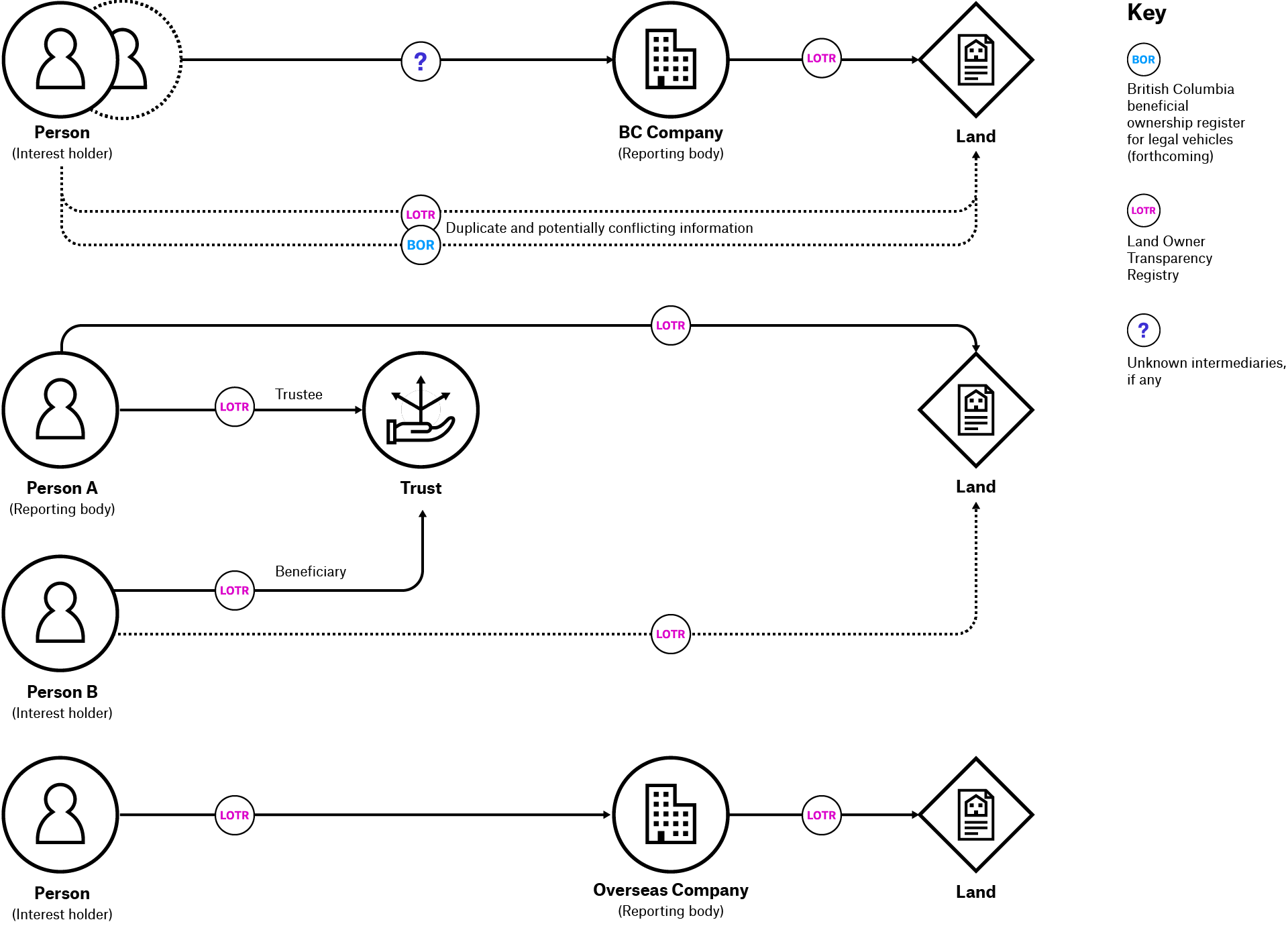
At the entity and person level, the LOTR collects detailed information on reporting bodies and interest holders, which in principle enables linkage with British Columbia’s business register and, in future, the Transparency Register with information about beneficial owners, currently under development. In practice, however, the LOTR and the Transparency Register will collect overlapping information using different definitions and thresholds. Under LOTA, one criterion for being a “corporate interest holder” in relation to a relevant corporation (i.e. one that holds an interest in land) is being an individual holding a “significant number of shares”, defined as directly or indirectly holding 10% or more of the issued shares or voting rights. [38] By contrast, British Columbia’s Business Corporations Act defines a “significant individual” holding a “significant number of shares” as an individual directly or indirectly holding more than 25% of shares or voting rights. [39] Filing timelines also differ: transparency reports under LOTA must be submitted within two months, whereas companies are required to update information on significant individuals within 15 days of a change under the Business Corporations Act. [40]
These definitional and temporal inconsistencies limit semantic interoperability and complicate comparison and linkage across registers. Apparent discrepancies between datasets may reflect genuine differences in legal scope, reporting thresholds, or update cycles, rather than errors or noncompliance. This challenge is illustrated in Figure 5.
More broadly, integration potential is further constrained by limited disclosure of personal and entity identifiers and the absence of bulk-access mechanisms, meaning that comprehensive analytical integration would require regulatory access or formal data-sharing arrangements.
Figure 5. Integration potential of the Land Owner Transparency Registry (illustrative example)
Footnotes
[27] RoS, “Register of Persons Holding a Controlled Interest in Land”.
[28] RoS, “Register of Persons Holding a Controlled Interest in Land – Search the register”, n.d., https://rci.ros.gov.uk/search-entry/search?_gl=1*eetj6c*_ga*MTQwMjA5Mzg4MC4xNzU3MzU5NTQx*_ga_JZFZYTPNNP*czE3NjUzNzU0MDEkbzExJGcxJHQxNzY1Mzc1NDMxJGozMCRsMCRoMA.
[29] Scottish Government, “Register of persons holding a controlled interest in land - Land reform”, n.d., https://www.gov.scot/policies/land-reform/register-of-controlling-interests/.
[30] RoS, “Land Register of Scotland”, last updated 29 July 2025, https://www.ros.gov.uk/our-registers/land-register-of-scotland; RoS, “General Register of Sasines”, 29 October 2024, https://www.ros.gov.uk/our-registers/general-register-of-sasines.
[31] Registers of Scotland, “Transparency Regimes - RoS Knowledge Base”, 11 July 2024, https://kb.ros.gov.uk/rci/do-i-need-to-register/transparency-regimes.
[32] LTSA, “Land Owner Transparency Registry”; Government of British Columbia, “Land Owner Transparency Act [SBC 2019]”, Chapter 23, 16 May 2019, https://www.bclaws.gov.bc.ca/civix/document/id/complete/statreg/19023.
[33] LTSA, “Searching Information in LOTR”, n.d., https://landtransparency.ca/search/.
[34] Government of British Columbia, “Interpretation of the Land Owner Transparency Act and Regulation”, updated 20 August 2024, https://www2.gov.bc.ca/gov/content/housing-tenancy/real-estate-bc/land-owner-transparency-registry/interpretation; LTSA, “Land Owner Transparency Registry Fact Sheet”, 1 April 2025, https://landtransparency.ca/wp-content/uploads/2025/04/2025-LTSA-LOTR-FactSheet.pdf.
[35] Government of British Columbia, “Interest holders: Indirect control”, updated 20 August 2024, https://www2.gov.bc.ca/gov/content/housing-tenancy/real-estate-bc/land-owner-transparency-registry/indirect-control.
[36] Government of British Columbia, “Land Owner Transparency Act [SBC 2019]”.
[37] LTSA, “How to Start a LOTR Filing”, n.d., https://landtransparency.ca/myltsa-help/transparency-declaration/.
[38] Government of British Columbia, “Land Owner Transparency Act [SBC 2019]”.
[39] Government of British Columbia, “Business Corporations Act [SBC 2002]”, Chapter 57, 30 December 2025, https://www.bclaws.gov.bc.ca/civix/document/id/complete/statreg/02057_055#section119.11.
[40] Government of British Columbia, “Bill 20 – 2023: Business Corporations Amendment Act, 2023”, https://www.bclaws.gov.bc.ca/civix/document/id/bills/billsprevious/4th42nd:gov20-1.