Bridging the gap for effective asset transparency: Analysing land registers and beneficial ownership data for legal vehicles
Registers of land ownership and restricted rights
HM Land Registry (England and Wales)
HMLR maintains two datasets covering corporate land ownership in England and Wales: [16]
- Commercial and Corporate Ownership Data (CCOD): UK companies owning property. [17]
- Overseas Companies Ownership Data (OCOD): overseas companies owning property. [18]
First released in 2017 and updated monthly, these datasets provide information on properties and current corporate proprietors only; they do not include historical ownership data. Coverage is limited to legal ownership by corporate and organisational proprietors, excluding private individuals, charities, and UK companies with overseas addresses.
The CCOD and OCOD datasets form part of a broader land registration system that includes full title records. However, only a limited subset of this information is published in structured, machine-readable format. Public access to the datasets is provided free of charge via HMLR Use land and property data portal, which offers CSV bulk downloads and a JSON API for registered users. [19] Information on individual owners is available for a fee, for which only the name of the owner is available. Title registration in England and Wales is compulsory and confers legally enforceable rights.
The datasets contain information about direct interests, namely legal ownership held by legal vehicles. They do not include indirect interests or other interests held by other parties through the legal vehicle, such as control or usufruct interests. While HMLR also holds information about charges (such as mortgages) and equitable interests (which may include information on beneficiaries where property is held in trust), this information is not systematically and comprehensively captured. Instead, either the legal owner or the interest holder may enter a restriction on the title to protect an interest through registration. These interests are not included in the datasets and are therefore outside the scope of this analysis.
Data model
The CCOD and OCOD datasets are structured around two core schema objects:
- Property: a registered land title in England and Wales.
- Proprietor: the registered legal owner of a property title, limited in these datasets to companies or other organisations.
Each entry includes basic property information and details of the registered proprietor, with up to four proprietors listed per title and a flag indicating when additional proprietors exist. Figure 2 summarises this structure.
Table 2. Data model of the HM Land Registry’s CCOD and OCOD datasets
| Schema object | Recorded information |
|---|---|
| Property |
Title number Property address Tenure (freehold/leasehold) Multiple address indicator Price paid (if recorded) |
| Proprietor (company or organisation) |
Proprietor name Company registration number Proprietorship category (e.g. private or public limited company, limited liability partnership) Proprietor address Date proprietor added Additional proprietor indicator (to be flagged if more than four proprietors exist) |
Identifiers
The datasets include the following identifiers:
- Title number: a unique identifier for registered property across HMLR datasets.
- Company registration number: the identifier assigned to corporate proprietors.
For UK-incorporated entities, company registration numbers are issued by Companies House, the UK’s company register. Overseas legal entities are identified using numbers from the Register of Overseas Entities (ROE), which is also maintained by Companies House. Under UK law, foreign entities that own UK property are required to register with the ROE and disclose their beneficial owners.
Together, these Companies House identifiers provide a reliable basis for linking land ownership records with BO and other corporate datasets, including for overseas proprietors.
Interest types
While the full HMLR captures many interest types – including ownership, mortgages, charges, covenants, restrictions, and other registered rights – the CCOD/OCOD datasets capture two types of legal ownership:
- Freehold: full ownership.
- Leasehold: time-limited ownership under a lease.
Other interests recorded on the title are omitted from the published datasets, and it is unclear whether structured versions exist elsewhere within HMLR systems.
Temporal information is limited to the “date proprietor added”. Where there are multiple owners, information on the form of joint tenancy or share of ownership is not available.
System integration
As HMLR datasets consistently use the same identifiers as Companies House datasets, and in structured, repeatable format (CSV and API), they can be reliably linked to the:
- Persons with Significant Control (PSC) register, including information on beneficial owners and relevant legal entities. [20]
- ROE, which contains BO information for overseas entities owning UK property.
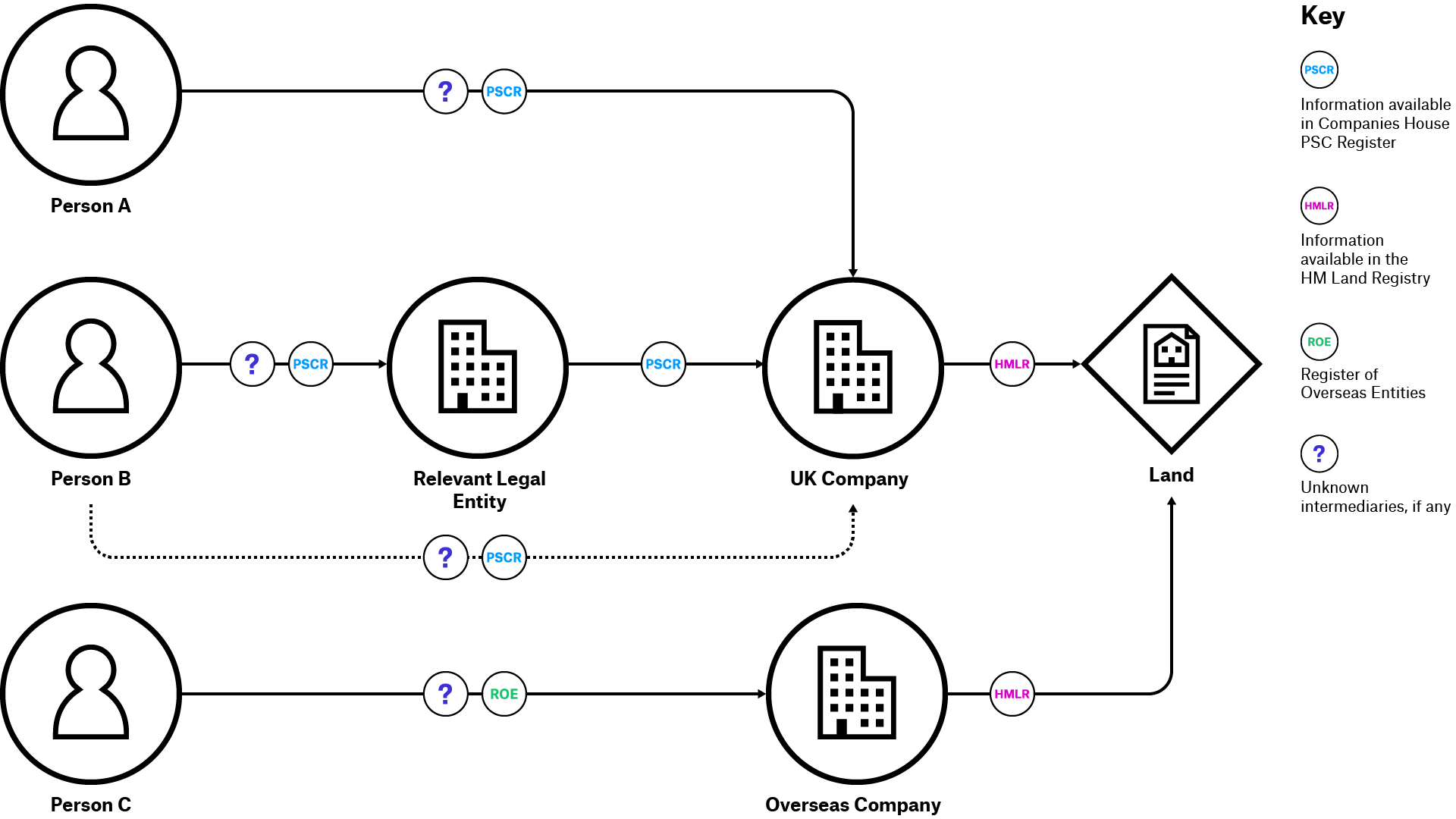
Linking the CCOD and OCOD datasets with Companies House and ROE data can therefore provide meaningful insight into the beneficial owners of corporate freeholders and leaseholders, even though the land datasets themselves do not provide information on beneficial owners or other indirect interests. However, shareholder data held by Companies House is often inconsistent and largely unstructured, and neither the PSC register nor the ROE indicates whether BO interests are held directly or indirectly. As a result, the presence, number, and identity of intermediary entities are unclear, except where relevant legal entities are explicitly disclosed.
The integration potential of HMLR is illustrated in Figure 2.
Figure 2. Integration potential of HM Land Registry (illustrative example)
Estonian Land Register (Kinnistusraamat)
The Estonian Land Register (also known as the e-Land Register), maintained by the Centre of Registers and Information Systems (RIK), is a legally authoritative register for immovable property. [21] It is electronically maintained and provides digital access to information on land ownership and registered rights, with the current XML-based data framework formalised in its present version in 2025. [22] Individual property-level searches are available through the public portal, while bulk or high-volume access is provided only through the XML service under a contractual agreement. [23] Entries take legal effect upon registration, and the register includes full historical records. [24]
The register provides information about direct interests between immovable properties and the interest-holders across a wide range of legally registered rights. It does not include information about parties that hold interests indirectly.
Data model
According to the XML service documentation, the register is structured around two core schema objects:
- Property: a registered cadastral unit, or group of units, entered as a distinct register part.
- Owner: a rightsholder, with an indicator distinguishing natural persons from legal persons.
Both property-level data and rights-holder information are highly structured and granular, as summarised in Table 3.
Table 3. Data model of the Estonian Land Register
| Schema object | Recorded information |
|---|---|
| Property |
Cadastral unit ID Register part and entry number Property address Land parcel attributes (area/size, unit, intended land use) Registered rights and encumbrances Mortgages and hypothecs |
| Owner (natural or legal person) |
For a natural person: Person name National ID Foreign identifier (if provided) Date of birth (if natural person) Registered address For a legal person: Legal name National registry code Foreign identifier (if provided) Registered address |
| Interest |
Ownership form (e.g. sole, joint, marital) Ownership share (fractional, e.g. 1/2, 1/3) Ownership start and end dates |
Identifiers
The Estonian Land Register uses several identifiers:
- katastritunnus: cadastral unit identifier;
- kande_number and registriosa_number: identifiers for the property’s register parts and individual rights entries;
- isikukood_registrikood: unified identifiers for natural persons and legal persons.
Identifiers for natural and legal persons are captured within a single unified scheme (isikukood_registrikood), which records either an Estonian national ID (for natural persons) or a registry code (for legal persons). For foreign rightsholders, a foreign personal or company identifier may be recorded where one is provided. The accompanying isik_tyyp field explicitly distinguishes natural from legal persons, representing a unified identification framework with an embedded type indicator.
As a result, Estonian legal persons and individuals are consistently identifiable, while foreign entities can be identified only to the extent that acceptable identifiers are supplied at registration. The register does not rely on a standardised foreign identification scheme, meaning that identifier quality and comparability may vary.
Interest types
The Estonian Land Register records a broad range of legally registrable rights and interests. [25] Each right is recorded as a separate register entry linked to the property and, where applicable, to its rightsholder. As a result, multiple rights and multiple rightsholders may coexist in relation to a single immovable asset. These include:
- Ownership: full legal title to the immovable property.
- Right of superficies (building rights): a right to own a building or structure situated on another person’s land.
- Usufruct: a right to use and benefit from property without ownership.
- Servitudes (easements): rights of use or access benefiting another person or property (e.g. rights of way).
- Mortgages and hypothecs: registered security interests securing a claim.
- Restrictions and encumbrances: registered, substantive limitations or burdens attached to the property that affects its use or disposal.
- Prohibitions: procedural entries temporarily restricting transactions (e.g. bans on sale or transfer), typically imposed in connection with court proceedings, enforcement actions, or pending claims.
- Pre-emption rights: priority rights to acquire the property upon sale.
- Apartment ownership: ownership and co-ownership arrangements linked to apartment units.
- Long-term leases or tenancy rights: leases that are legally registrable in the land register.
- Court or contract-based rights: rights arising from judicial decisions or contractual instruments.
The register distinguishes between several forms of ownership, including:
- sole ownership;
- joint ownership;
- joint marital property;
- apartment and other co-ownership arrangements; and
- public-sector ownership forms.
Where relevant, ownership and other rights are recorded with fractional shares as well as start and end dates.
System integration
The use of shared identifiers – in particular the Estonian legal entity identifier (registrikood) used across RIK-managed systems – combined with RIK’s unified technical architecture, enables joining the information with publicly accessible data from the Estonian e-Business Register, including: [26]
- beneficial owner declarations;
- shareholder data;
- commercial register information; and
- company annual reports.
This allows for a detailed understanding of BO networks that include Estonian legal entities. For land owned by foreign entities, this depends on the availability of information from the respective jurisdiction.
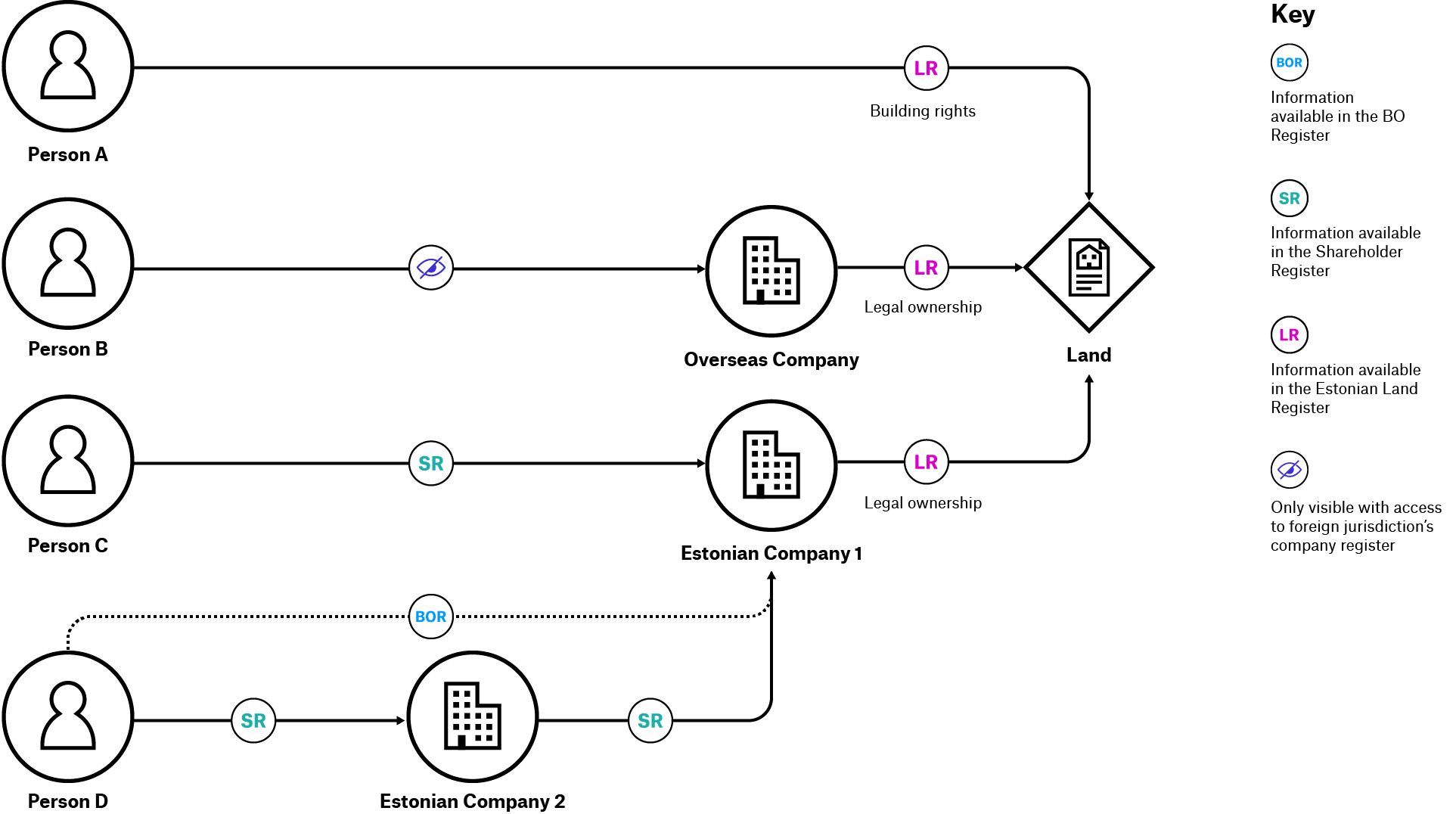
The main limitation for this analysis is restricted access to land data in bulk, which is not applicable to those with contractual access to the XML service. The breadth of interest types recorded expands analytical scope and enhances visibility over direct relationships, as illustrated in Figure 3, where different arrow colours denote distinct categories of interests.
Figure 3. Integration potential of the Estonian Land Register (illustrative example)
Footnotes
[16] UK Government, “HM Land Registry”.
[17] UK Government, “UK companies that own property in England and Wales”, n.d., https://use-land-property-data.service.gov.uk/datasets/ccod.
[18] UK Government, “Overseas companies that own property in England and Wales”, n.d., https://use-land-property-data.service.gov.uk/datasets/ocod.
[19] UK Government, “HM Land Registry – Use land and property data”, n.d., https://use-land-property-data.service.gov.uk/.
[20] A relevant legal entity can be reported in lieu of a beneficial owner in cases where this is a UK-registered legal entity, and this entity holds an interest that would meet the criteria of beneficial ownership if it were a natural person, and it is the first entity in the chain.
[21] RIK, “E-Land Register Portal”.
[22] RIK, Kinnistusraamatu XML päringud (RIK, 2025), https://www.rik.ee/sites/default/files/2025-01/Kinnistusraamatu%20XML%20teenus_jaan2025.pdf.
[23] RIK, “E-Land Register – Search”, n.d., https://kinnistusraamat.rik.ee/Avaleht.aspx?lang=Eng; RIK, “E-Land Register Portal – XML Service”, n.d., https://www.rik.ee/en/e-land-register/e-land-register-portal/xml-service.
[24] Republic of Estonia, Riigi Teataja, Land Register Act, § 9, 15 January 2025, https://www.riigiteataja.ee/en/eli/515012025007/consolide.
[25] As defined under the Land Register Act (Kinnistusraamatuseadus) and the Property Law Act (Asjaõigusseadus). See: Republic of Estonia, Riigi Teataja, Land Register Act, 25 March 2019, https://www.riigiteataja.ee/en/eli/525032019009/consolide; Republic of Estonia, Riigi Teataja, Law of Property Act, 29 August 2019, https://www.riigiteataja.ee/en/eli/529082019011/consolide.
[26] RIK, E-Business Register Open Data, “Downloading open data”, n.d., https://avaandmed.ariregister.rik.ee/en/downloading-open-data#pk.