Enhancing beneficial ownership data collection and use in Nigeria
Part 1: Nigeria’s beneficial ownership journey
Building momentum for reform
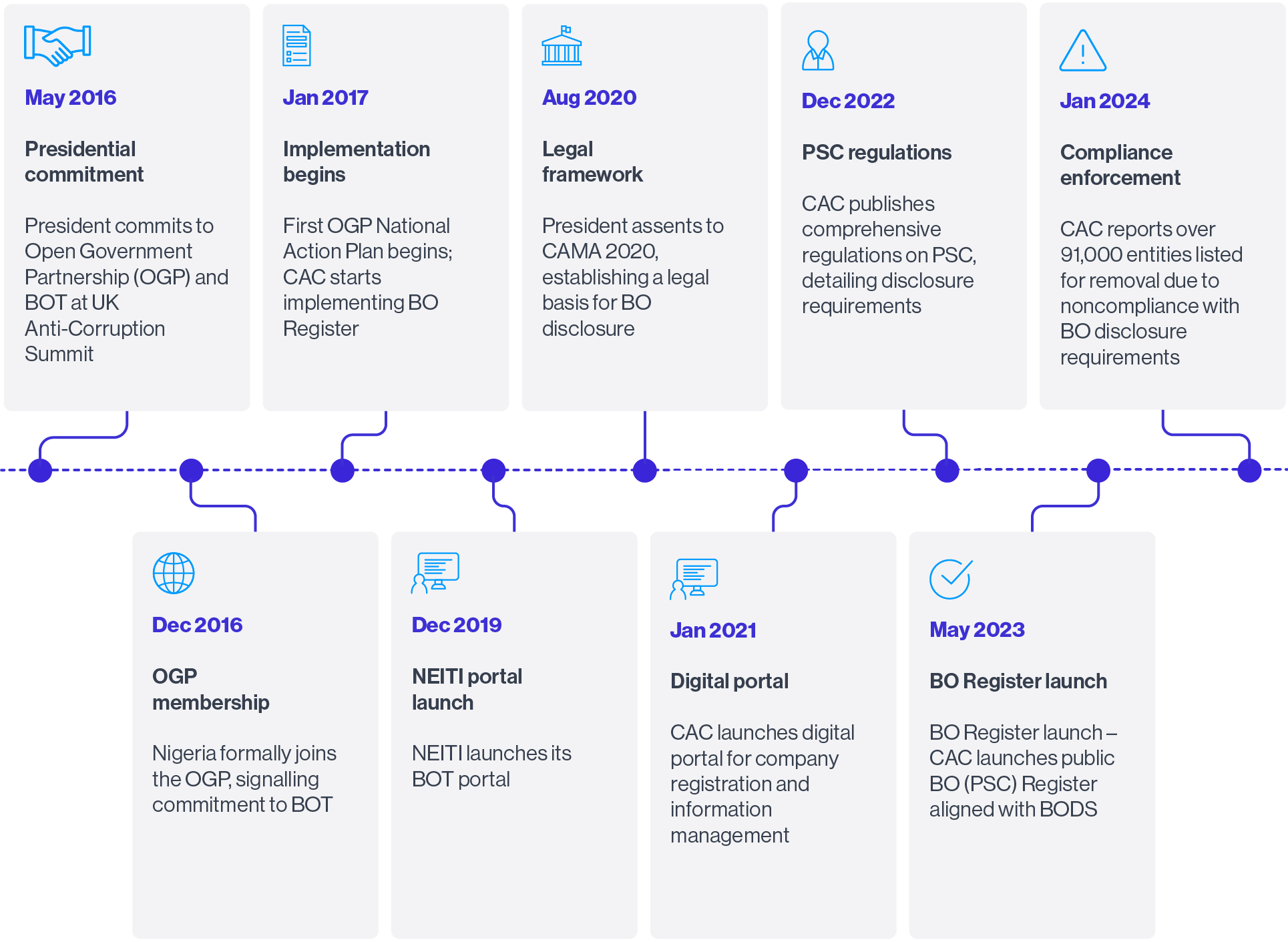
Nigeria’s commitment to BOT emerged from a convergence of domestic reform priorities and international accountability standards. At the London Anti-Corruption Summit in May 2016, Nigeria made a formal pledge to establish a public central register of BO information, reinforcing its existing leadership through the Extractive Industries Transparency Initiative (EITI). [6]
Prior to the CAMA 2020, the legal framework provided no mechanism to identify natural persons controlling corporate entities. The original CAMA 1990 focused solely on directors and registered shareholders, leaving authorities unable to trace actual economic beneficiaries. This gap significantly limited efforts to combat corruption, money laundering, and illicit financial flows.
Aligning with global standards
Nigeria’s reform efforts align with two critical global frameworks, among others: the FATF Standards for combating money laundering and terrorist financing and the EITI Requirements for extractive sector transparency. [7]
FATF Standards: First adopted in 2003 and formalised in 2012, the FATF’s BO standards mandate that competent authorities have prompt, efficient access to comprehensive basic BO information for all corporate entities. Nigeria’s implementation through CAMA 2020 directly addresses these requirements.
EITI Requirements: The 2013 EITI Standard introduced BO provisions for the extractive sector, recommending the establishment of public registers. Nigeria volunteered as a pilot country in 2013, with NEITI successfully launching its sector-specific register in December 2019.
Nigeria’s framework compares favourably with international standards. The 5% ownership threshold is stricter than the 25% benchmark common in the European Union and many FATF jurisdictions, particularly appropriate for high-risk sectors. Nigeria’s approach to control definitions, indirect ownership tracing, and company-level reporting duties mirrors practices in the United Kingdom (UK) while adapting to the local context.
Figure 1. Nigeria’s Beneficial Ownership Journey. A decade of transparency and accountability (2016-2026)
Implementing the vision
Following Nigeria’s 2016 commitment to the Open Government Partnership (OGP), the government embedded BOT into its inaugural National Action Plan (2017) and assigned leadership to the CAC. [8]
The CAC pursued a comprehensive two-pronged strategy: establishing legal foundations through legislative reform; and developing technical infrastructure. International support proved instrumental in this. The World Bank’s Multi-Donor Trust Fund provided USD 400,000 in development grants, complemented by strategic backing from the OGP. Open Ownership delivered hands-on technical assistance, ensuring alignment with global data quality standards. A Nigerian company, contracted by the CAC, developed the digital platform, creating an automated portal for secure data storage and access.
The official launch on 25 May 2023 marked Nigeria as the first African country to implement such a comprehensive system. The platform leverages BODS to ensure structured, high-quality data collection. The public search portal enables searches by company name, registration number, or individual name while complying with data protection regulations. [9]
The API infrastructure and login access provide LEAs, such as the NFIU and EFCC, with real-time access to comprehensive data not available through public search. This integration enables efficient investigations, discrepancy flagging, and cross-referencing with other datasets, supporting government-wide efforts to combat corruption, money laundering, and illicit financial flows.
From challenge to achievement: Exiting the FATF grey list
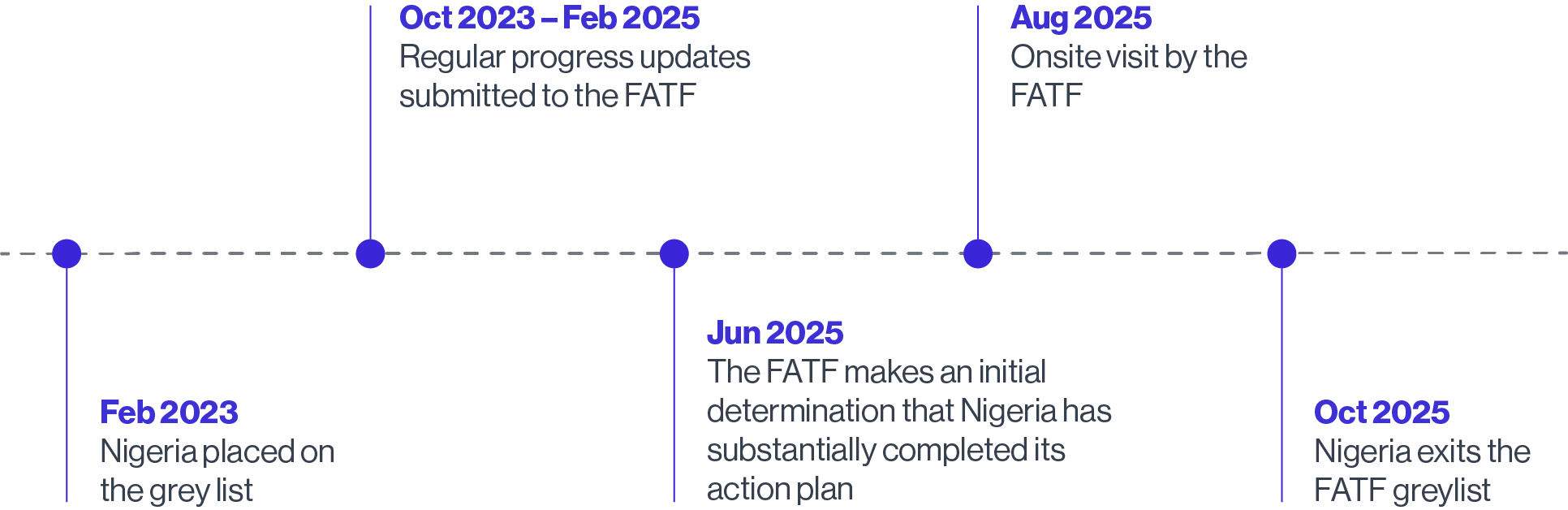
In February 2023, the FATF announced that Nigeria had been placed on its grey list. This decision followed the release of findings from the second FATF Mutual Evaluation Exercise, which began in 2019 and concluded in 2021. [10] The report assessed two key areas: technical compliance and effectiveness. Technical compliance evaluated the legal, regulatory, and institutional frameworks in place, while effectiveness measured how well these systems work in practice towards anti-money laundering (AML) and combating the financing of terrorism (CFT). The Inter-Governmental Action Group against Money Laundering (GIABA), a FATF-style regional body, released a Mutual Evaluation Report in August 2021. In this report, Nigeria was found to be compliant or largely compliant with 26 of the FATF’s 40 recommendations, partially compliant with 11, and noncompliant with 3. [11]
One of the key findings of the report stated that:
“Reporting entities are obliged to collect and maintain beneficial ownership information (BO information) of legal persons before they establish a business relationship with them. Competent authorities, including LEAs, can access this information along with basic information held by the Corporate Affairs Commission (CAC). However, CAC does not have a mechanism in place to systematically collect and maintain BO information, and this impacts the transparency and verification of beneficial owners of legal persons.” [12]
Due to the low ratings in the 2021 Mutual Evaluation Report, Nigeria was placed under GIABA’s Enhanced Follow-up Process and the FATF International Cooperation Review Group process. [13] As a result, Nigeria was given a one-year observation period to implement 84 recommended actions.
By 2023, the FATF recognised that Nigeria had addressed 69 of the 84 actions, but the remaining 15 were deemed strategically significant, leading to greylisting in February 2023. Following Nigeria’s greylisting, the FATF issued a 19-point action plan with strict deadlines to prevent the country from being blacklisted. This targeted plan was separate from the original 84 requirements and focused exclusively on the most critical remaining deficiencies. The action plan also required Nigeria to, among other things, ensure that competent authorities have timely access to accurate and up-to-date BO information on legal persons and apply sanctions for breaches of BO obligations. [14]
Between February 2023 and October 2025, Nigeria viewed the FATF greylisting as a “call to action” and enacted a comprehensive, coordinated response. With the NFIU providing coordination and leadership, Nigeria actively pursued the implementation of the FATF’s action plan. Key agencies were involved, including the NFIU as coordination lead, with the EFCC, the ICPC, the Central Bank of Nigeria, the Securities and Exchange Commission (SEC), the CAC, and others.
As part of its operational implementations, Nigeria launched the BO Register in May 2023, in accordance with the CAMA of 2020, to enhance corporate transparency and accountability. This register provides competent authorities with timely access to BO information. The May 2023 launch of the BO Register provided competent authorities with timely access to ownership information, directly addressing the fourth action point in the FATF’s action plan.
The timeline of progress reviews
Between 2023 and 2025, Nigeria submitted six progress reports demonstrating systematic advancement. The FATF’s June 2025 determination confirmed that Nigeria had successfully addressed all 19 action items. Following an August 2025 onsite visit, the FATF removed Nigeria from the grey list during its October plenary meeting. Nigeria has been invited to join the FATF Guest Jurisdictions Initiative for one year, allowing it to participate in FATF meetings in 2026. It is also a full member of GIABA.
Figure 2. Nigeria’s FATF Greylist Journey
This achievement demonstrates Nigeria’s capacity for coordinated reform and lays a foundation for continued improvement in BOT. This success can be attributed to strong political will from the highest levels of government to demonstrate progress, effective coordination among regulatory and enforcement agencies led by the NFIU, and continuous implementation and regular monitoring.
Footnotes
[6] Republic of Nigeria, “Country Statement from Nigeria, London Anti-Corruption Summit”, 12 May 2016, https://assets.publishing.service.gov.uk/media/5a81aeaaed915d74e33ff86b/NIGERIA-_FINAL_COUNTRY_STATEMENT-UK_SUMMIT.pdf.
[7] FATF, International Standards on Combating Money Laundering: The FATF Recommendations (FATF, updated 2025), https://www.fatf-gafi.org/content/dam/fatf-gafi/recommendations/FATF%20Recommendations%202012.pdf.coredownload.inline.pdf; EITI, EITI Requirements (EITI, 2023), https://eiti.org/eiti-requirements.
[8] Open Government Partnership (OGP), OGP Nigeria National Action Plan (2017 – 2019) (OGP, 2017), https://www.opengovpartnership.org/wp-content/uploads/2017/05/Nigeria_NAP_2017-2019.pdf.
[9] Corporate Affairs Commission, “Federal Republic of Nigeria Persons with Significant Control (PSC) Register”.
[10] FATF, “Jurisdictions under Increased Monitoring”, 27 October 2023, https://www.fatf-gafi.org/en/publications/High-risk-and-other-monitored-jurisdictions/Increased-monitoring-october-2023.html.
[11] GIABA, Anti-money laundering and counter-terrorist financing measures: The Federal Republic of Nigeria – Mutual Evaluation Report (GIABA, 2021), https://www.fatf-gafi.org/content/dam/fatf-gafi/fsrb-mer/GIABA-Mutual%20Evaluation%20Report%20of%20the%20Federal%20Republic%20of%20Nigeria.pdf.coredownload.inline.pdf.
[12] GIABA, Mutual Evaluation Report, 9.
[13] GIABA, Mutual Evaluation Report, 247, 279.
[14] FATF, “Jurisdictions under Increased Monitoring – Nigeria”, 24 February 2023, https://www.fatf-gafi.org/en/publications/High-risk-and-other-monitored-jurisdictions/Increased-monitoring-february-2023.html#Nigeria.