Connecting ownership data: Practical pathways to tackle cross-border financial crime
Perspectives on interoperability
2 Interoperability
Interoperability, at its core, means information systems are able to interconnect, allowing data from different sources to be shared, exchanged, and interpreted consistently, even when underlying legal frameworks, technical infrastructures, and institutional arrangements are not identical.
As illustrated in the use cases in the previous section, users’ needs for BO data may vary widely – from searching multiple datasets in order to identify named persons or companies, to combining information from multiple sources to create complete networks of ownership.
In recent years, there has been increasing discourse at a policy level about the value of BO data being interoperable. However, within this discourse there has been limited clarity over what this really means, and therefore what solutions are required. Drawing on the expertise and insights of the Taskforce, and research undertaken to date, interoperability can be conceptualised as comprising three interrelated dimensions:
- Semantic interoperability: Ensuring that the meaning of data is interpretable across jurisdictions and providing common references to align the structure and content of the data.
- Technological interoperability: Providing the digital infrastructure and tools that make data-sharing and exchange secure, reliable, and doable in real time, supporting entity resolution and facilitating effective use of the data.
- Governance interoperability: Establishing the institutional frameworks and rules that allow jurisdictions to legally and trustfully share domestic data as well as to sustain and be accountable for the interoperable ecosystems.
Figure 1. Interoperability dimensions
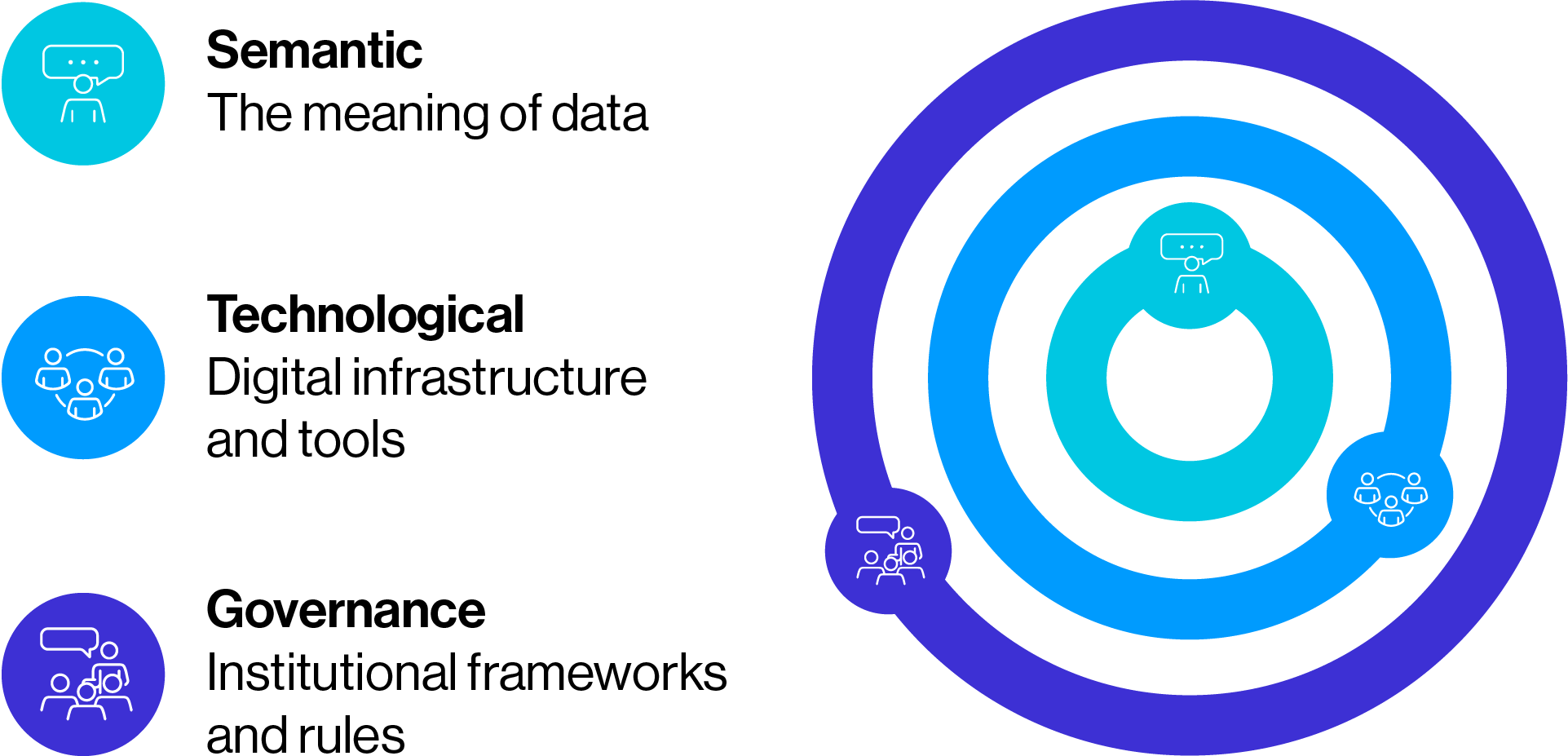
In the context of beneficial ownership, true interoperability requires alignment across semantic (shared meaning), technological (standards and interfaces), and governance (rules, trust, and accountability) dimensions.
Legal considerations are observed to cut across all three dimensions:
- Semantic: The way concepts represented in the data are defined is most often rooted in domestic legal frameworks.
- Technological: The solutions used to deliver secure and trusted data-sharing – for example, in compliance with data protection and privacy requirements – depend on domestic or regional legal data protection and access provisions.
- Governance: The way the interoperability infrastructure is resourced and governed relies on the legal mandates and enforcement capacity of relevant institutions.
The central challenge for advancing meaningful interoperability of BO data is to bring these dimensions together into a coherent and practical approach, while also taking legal considerations into account.
2.1.1 Clarifying key terms: Access, data-sharing, data exchange, and interoperability
Discussions on beneficial ownership often interchangeably use terms such as access to data, data-sharing, data exchange, and interoperability. Clarifying these distinctions is essential to avoid misunderstandings and ensure that policy, technical, and governance solutions are appropriately targeted.
Table 1. Clarifying key terms
| Term | What it means | Typical characteristics | Limitations | Relationship to interoperability |
|---|---|---|---|---|
| Access to data | The ability for a user to view or retrieve data directly from the source |
– Human- or machine-readable portals – Public or restricted access – Often read-only |
– Data may be read-only and have restrictions on reuse – Limited automation – Meaning can be unclear outside national context |
Access is a precondition but does not enable interoperability on its own |
| Data-sharing | The practice of one agency sending data to another agency |
Example from simple email exchange through to dedicated data exchange platforms (see below) Typically purpose specific |
– Fragmented arrangements – Limited scalability – Inconsistent structures and definitions |
Data-sharing can be a foundation for interoperability, but the shared data may not be interoperable |
| Data-sharing agreement | Agreement for the controlled provision of data exchange between entities, under defined conditions |
– Bilateral or multilateral agreements – Legal or contractual permissions – Typically purpose-specific |
– Only provides a legal or policy basis for exchange | Data-sharing agreements can be a foundation for interoperability but do not guarantee it |
| Data exchange | Technical transmission of data between systems |
– APIs, bulk downloads, messaging protocols – Machine-readable formats |
– May lack shared semantics – Technical compatibility does not guarantee shared meaning |
Data exchange is a technical enabler of interoperability |
| Interoperability | Ability of systems to exchange data, and to interpret it consistently and reliably across contexts |
– Shared semantics and identifiers – Compatible interfaces – Governance and trust frameworks |
– Requires coordination across institutions, law, and technology | Interoperability builds on access, sharing, and exchange to enable cross-border usability |
While the Taskforce’s main aim was to examine pathways towards interoperable BO data, it quickly became clear that in many contexts and for many users, there were significant issues with access to BO data. Therefore, while the Taskforce maintained a focus on the goal of interoperability of BO data, it necessarily had to also focus on access to data, data-sharing agreements, and data exchange.
3 Three perspectives on interoperability
This section outlines the three core perspectives through which the Taskforce has examined BO interoperability: semantic, technological, and governance. Rather than treating interoperability as a purely technical challenge, the Taskforce’s discussions underscored that meaningful cross-border use of BO data depends on shared understanding of data meaning; reliable mechanisms for access and exchange; and trusted institutional arrangements that define responsibilities, safeguards, and accountability. This section sets out how these perspectives are interconnected, and how progress in each is necessary to move from fragmented national systems toward interoperable solutions that deliver practical value to data users.
3.1 Semantic perspective: Speaking the same language
There are significant differences in the quality of BO information that is collected in different jurisdictions. Countries have different definitions of beneficial ownership, and they often have different thresholds for disclosure of BO information, as well as varying data formats to collect it. While there are valid reasons for many of these differences, they add complexity when connecting and interpreting BO information from different countries. Some key use cases of BO information, such as understanding the nature of an individual’s BO relationship across companies in several jurisdictions, require a level of common understanding of the meaning of beneficial ownership in different jurisdictions.
3.1.1 Challenges identified through Taskforce work
The following have been highlighted by users of BO data within the Taskforce’s work as known gaps or challenges in semantic interoperability between different BO registers.
- Different ownership definitions and thresholds (e.g. 10%, 20%, 25%) and different definitions of “control”, leaving potential gaps in disclosure across jurisdictions and making it challenging to compare and interpret information from different registers.
- Inconsistent field definitions, for example, whether “senior management” qualifies as a beneficial owner.
- Inability to match individuals and companies included in different datasets: Lack of identifiers, particularly for beneficial owners and in some cases for companies, makes it challenging to determine whether the same person or company name within two datasets is referring to the same individual or company.
3.1.2 Approaches to semantic alignment and coherence
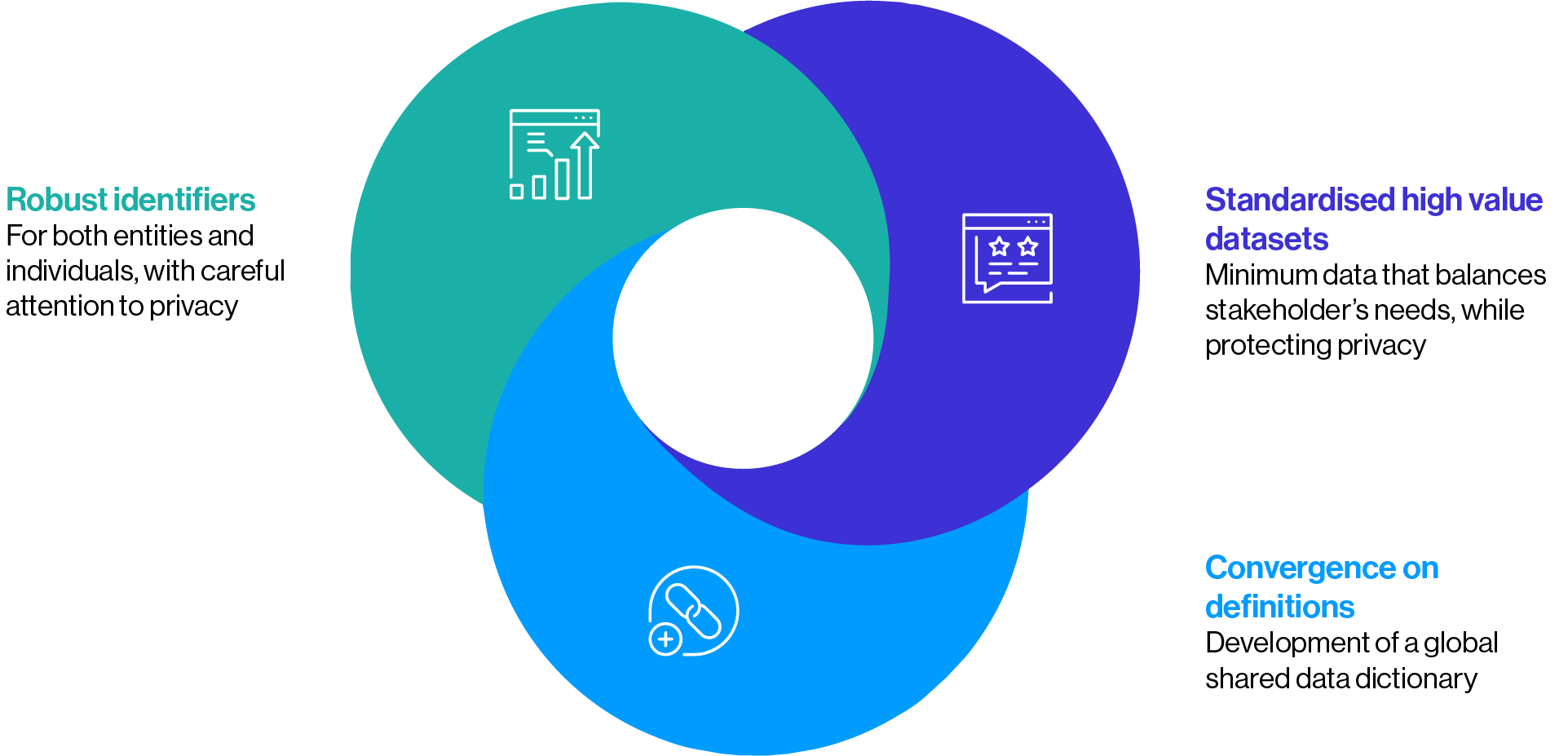
Given the variations in domestic BO registers – some of which are a necessary response to contextual differences – semantic interoperability is proposed as building a shared understanding of the core data elements to drive alignment between systems, as opposed to requiring identical approaches to be taken within all BO registers. The resulting building blocks have been used within BOT or adjacent sectors to help with this and offer instructive lessons for the BO field. These include:
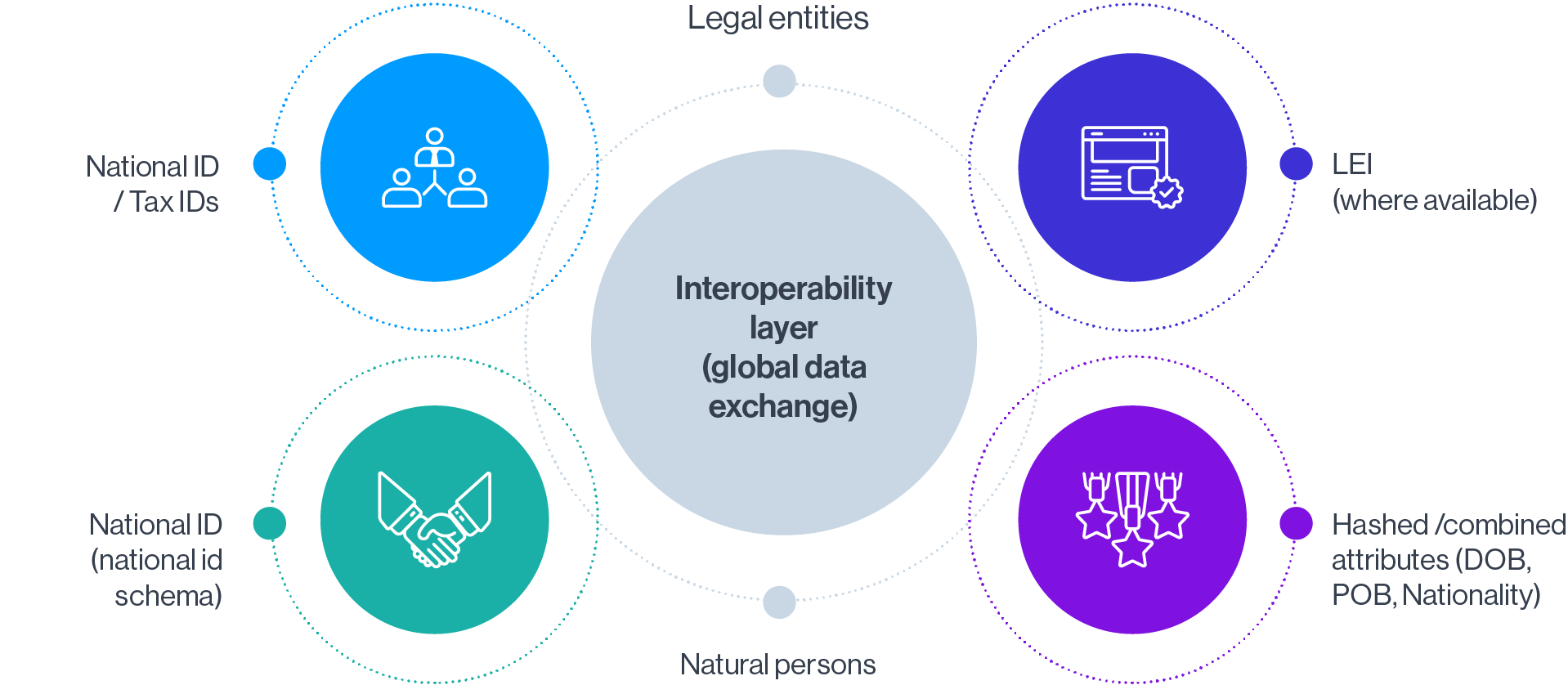
- Common identifiers: The Taskforce’s discussions suggested flexible identifier models, where legal vehicles are identified using national IDs or tax numbers as a baseline and linked to the global legal entity identifier (LEI) system where available; and natural persons are identified through privacy-preserving composite keys (e.g. date of birth and nationality), or hashed IDs under strong governance controls.
- Determining an MHVDS: A reference subset of essential fields that all source datasets should make available to relevant data users to enable the range of necessary use cases.
- A cross-border core vocabulary: A standard vocabulary that aligns BO data fields, ownership types, and legal forms across jurisdictions, building on BODS and the Open Ownership Principles. [7]
- Use of standardised data models and schemas: Technical data standards such as BODS offer a conceptual framework to semantically align non-identical information.
Figure 2. Semantic interoperability
3.1.3 Minimum high-value datasets
While considering data protection and privacy law, deciding which fields can be shared with which stakeholders, and how, has been a recurring challenge in BOT policy. For example, some jurisdictions have chosen to provide direct access for all users to a selection of data fields (sometimes limited and often not sufficient to easily tell individuals apart) by setting publicly accessible and searchable registers. Others have restricted access (sometimes to more data fields) to a limited number of domestic government agencies. Others yet have gone for a hybrid approach where a wider range of stakeholders can access a more extensive selection of fields, while still guaranteeing fuller access to selected authorities, based on the targeted policy goals.
Conducting research to understand the practical use cases undertaken by a range of diverse data users is essential to design systems that provide the right information to users while finding a balance between data usability, comparability, and data protection and privacy laws implemented in or across different jurisdictions.
Case study 1: Specifying beneficial ownership fields available through interconnected registers in the European Union’s Anti-Money Laundering Directives
Under the EU’s Anti-Money Laundering Regulations (AMLR), the following fields of BO information for legal entities and arrangements are required:
(a) all names and surnames, place and full date of birth, residential address, country of residence and nationality or nationalities of the beneficial owner, number of identity document, such as passport or national identity document, and, where it exists, unique personal identification number assigned to the person by his or her country of usual residence, and general description of the source of such number;
(b) the nature and extent of the beneficial interest held in the legal entity or legal arrangement, whether through ownership interest or control via other means, as well as the date as of which the beneficial interest is held;
(c) information on the legal entity of which the natural person is the beneficial owner in accordance with Article 22(1), point (b), or, in the case of legal arrangements of which the natural person is the beneficial owner, basic information on the legal arrangement;
(d) where the ownership and control structure contains more than one legal entity or legal arrangement, a description of such structure, including names and, where it exists, identification numbers of the individual legal entities or legal arrangements that are part of that structure, and a description of the relationships between them, including the share of the interest held [8]
For a legal entity:
(i) legal form and name of the legal entity;
(ii) address of the registered or official office and, if different, the principal place of business, and the country of creation;
(iii) the names of the legal representatives of the legal entity as well as, where available, the registration number, the tax identification number and the Legal Entity Identifier
(iv) the names of persons holding shares or a directorship position in nominee form, including reference to their status as nominee shareholders or directors. [9]
Table 2. Sample minimum high-value datasets
| Dimension | Full dataset (BO Register) | Minimum high-value dataset |
|---|---|---|
| Legal vehicle data | ID, name, legal form, status, incorporation date, address, sector | ID, name, legal form, status, sector, jurisdiction |
| BO data | Full name, date of birth (DOB), place of birth (POB), nationality/ies, address, ID number, ownership percentage, control type, acquisition/cessation dates | Full name, month and year of birth, nationality/ies, residence country, ownership percentage, control type, acquisition/cessation dates |
| Intermediary ownership | Detailed chain with intermediate entity info | Basic linkages (direct/indirect flag and intermediate entity ID) |
| Verification | Filing source, verification status, sanctions flags | Date of last update and filing source |
| Privacy and accessibility | Often restricted for addresses, ID numbers | Privacy-preserving, but sufficient for AML, tax, procurement, and transparency use |
3.1.4 Defining a minimum high-value dataset
Effective use of BO data across AML, procurement oversight, investigations, and other use cases often requires the ability to link individuals to entities across jurisdictions. However, fragmentation in data standards and availability continues to limit cross-border interoperability.
The Taskforce conducted a targeted survey to identify the minimum set of BO data elements required to support the most critical use cases. Findings are based on a small, non-representative sample, and should be interpreted as indicative rather than statistically conclusive.
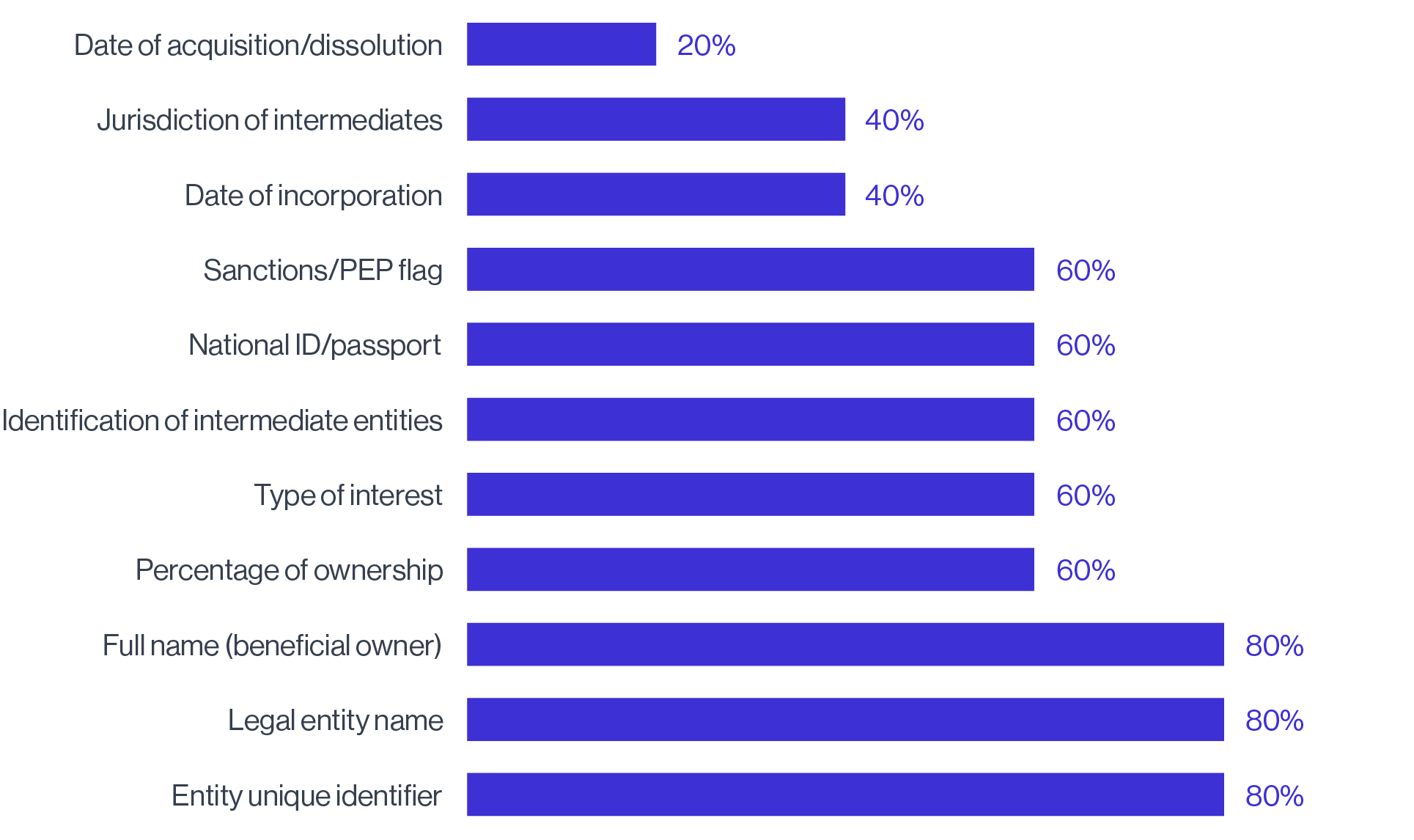
Despite differences in institutional roles, respondents converge on a small but robust core dataset. This dataset is defined by its ability to enable identity resolution and ownership tracing.
Core MHVDS from survey respondents include:
- legal entity name;
- entity unique identifier;
- beneficial owner’s full name;
- beneficial owner’s DOB (at least partial);
- percentage of ownership;
- type of interest; and
- identification of intermediate entities.
Figure 3. Analysis of responses shows that data requirements are shaped by four primary use cases
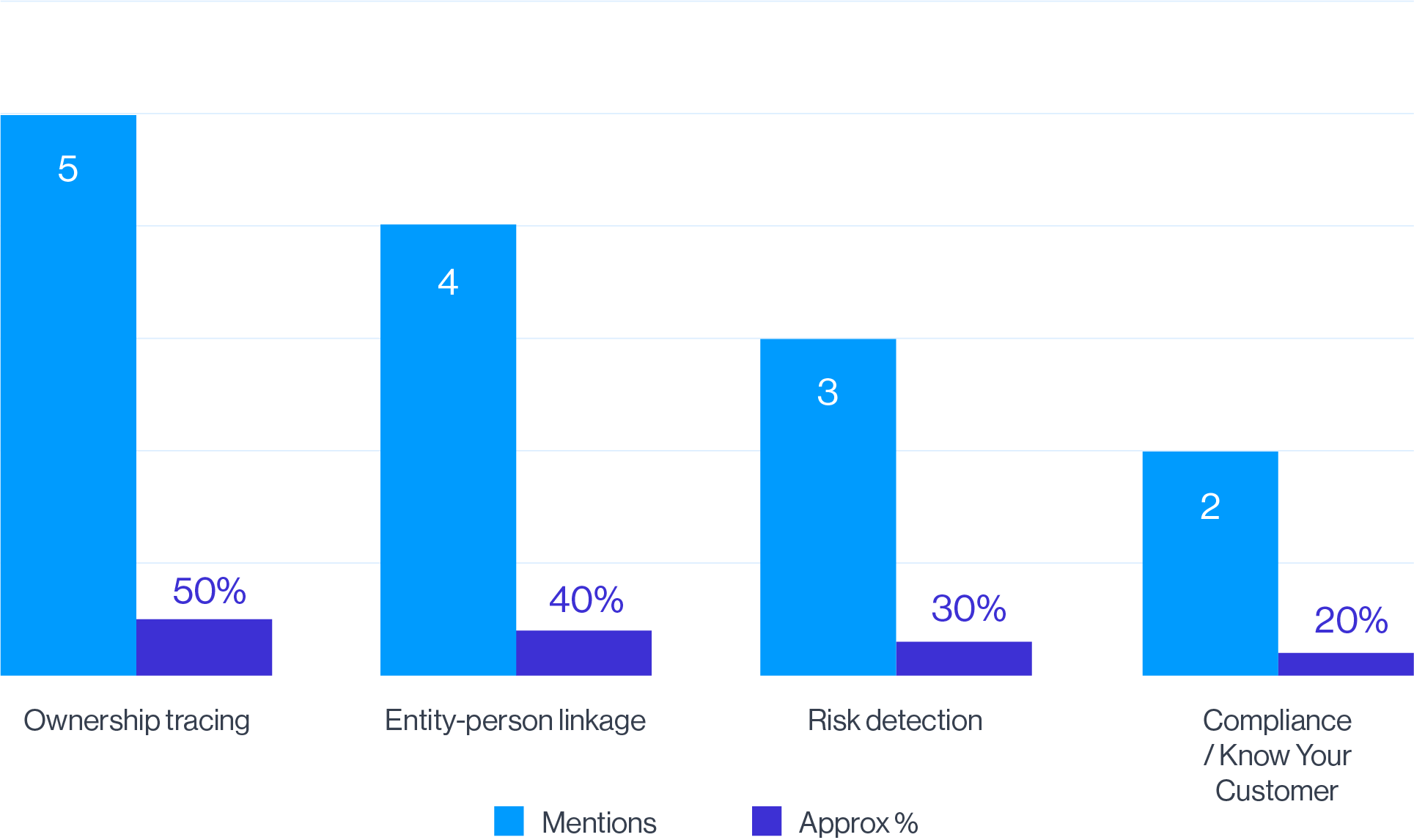
Across the above use cases identified by survey respondents, a consistent pattern emerges:
- Identifiers and ownership relationships are indispensable.
- Contextual data becomes important only for specific functions.
When forced to prioritise, respondents consistently selected the same set of elements, confirming the existence of a practical minimum dataset.
Figure 4. Most frequently prioritised elements
3.1.5 Balancing usability and privacy through layered access models
The above survey results, together with the wider work of the Taskforce, suggest that while a small set of core data fields can enable basic interoperability (specifically, those that support identification and ownership tracing), many important use cases require additional context.
However, not all data elements are equally required for all users or use cases, and some are more sensitive to share. For instance, categorising fields of information as part of: the core dataset; an extended higher-value dataset that enables additional use cases; and those containing the most sensitive information offer a basis to delineate an archetypal layered datasets model. The nature of information deemed sensitive will vary across contexts. The data fields in each layer of dataset are only one aspect of how data enables various use cases. A broader set of usability features will be required in each layer, including how flexibly it can be used. Open Ownership’s briefing on designing effective access to BO information provides further details on how to use layers to balance privacy and usability. [10]
Table 3: Example of layered datasets
| Core dataset: Enables basic interoperability of BO information across jurisdictions and with other datasets | Beneficial owner’s identity and legal vehicle’s ownership structure |
| Extended dataset: Provides higher value to support additional use and use cases | For example, nationality/ies, incorporation data, PEP flag |
| Restricted dataset: Contained in sensitive data fields, but may be necessary for specific use cases | For example, national ID, full DOB, residential address |
Given that certain high-value data points, particularly national identifiers, full DOBs, and residential addresses, are both operationally valuable and highly sensitive, layered access models may be well placed to ensure that such information is available to only certain categories of users, while supporting broader access to the core dataset for others. For example:
- Full access is granted to competent authorities in line with policy goals.
- Extended or high-value access (e.g. to all but the most sensitive fields) is provided to a set of dedicated user groups in accordance with policy goals.
- Limited access (e.g. to key information such as a beneficial owner’s name) is more widely available.
These findings suggest that a binary approach (public vs. non-public) will be insufficient to enable the range of use cases of BO data. By contrast, defining an MHVDS appears to be both feasible and actionable. The true “minimum” is not about reducing data, but rather ensuring that the right data, identity, and ownership relationships can flow seamlessly across borders. This provides a strong foundation for developing a practical and global MHVDS.
3.1.6 Common identifiers as a core component of a minimum high-value dataset
Reliable identifiers are critical for enabling resolution between information included in different datasets. However, due to their privacy-sensitive nature, reliable identifiers for individuals are less likely to be used in information sources from different jurisdictions. The use of hashed identifiers provides a promising avenue for solutions to some of these issues. However, while this may satisfy some use cases (e.g. analysing trends and patterns of risks of corruption or tax fraud across a whole dataset), others may require more specifically identifying beneficial owners and links to individuals within their network, including across borders (e.g. investigating cases of public-funds embezzlement or money laundering related to criminal activities). In these cases, data users require more data fields to identify individuals with confidence across different data sources.
Case study 2: The European Union and Western Balkans’ approach to company identifiers
One of the essential elements in the minimum dataset of the BIFIDEX initiative’s “interoperable core” was a set of unique identifiers for entities. Pioneered by BRIS, the implementation of the European Unique Identifier (EUID) became both a common semantic reference point to understand data and uniquely identify legal vehicles, and a technical bridge connecting national company identifiers into a coherent European identity model. This approach could be directly applied in the context of BO interoperability, ensuring that all domestic registers include national and/or regional unique identifiers for legal vehicles and agree to make it a key part of an interoperable core. [11]
Figure 5. Common ID considerations
3.1.7 A cross-border data framework
To help policy and technical teams in charge of BO registers to define, understand, and use a shared semantic foundation and improve systems’ interoperability, stakeholders could draw on relevant existing standards and principles to create a shared reference framework.
Various international policy standards and laws – including the Financial Action Taskforce (FATF) Recommendations, the EU’s Anti-Money Laundering Directives (AMLD) and AMLR, and the United Nations Convention against Corruption (UNCAC), have been guiding cross-border alignment on conceptual alignment and policy design. Tools such as Open Ownership’s Principles for effective BO disclosure can inform the development of a data catalogue, dictionary, or similar semantic layer aligned to international standards by providing clear guidance on the definitions of BO legal concepts; the level of detail to collect in BO information; or how to approach different types of ownership and control interests across jurisdictions. [12]
Many code lists that are not specific to BO data can also help standardise the information contained in BO datasets, such as ISO country codes, market identifier codes, or date formats.
Case study 3: Lessons from the Business Registers Interoperable System and the Business and Financial Data Exchange in achieving semantic alignment
The EU’s BRIS and the Western Balkans’ BIFIDEX initiative offer instructive examples for how semantic alignment can enable interoperability across different national systems (see Annex 1 and 2 for more details). In both contexts, semantic alignment was driven by the need for better cross-border information where there are close economic links between different countries:
- BRIS was driven by the need for better access to high-quality information about European business processes, such as mergers or headquarter transfers across borders; and
- BIFIDEX aimed to create a digital infrastructure for a functioning regional single market.
Across both initiatives, countries’ legal or administrative need to share official company data across borders required reconciling datasets that represented different national understandings and legal frameworks of various business concepts, including what a “company” is, how it is registered, and how it is legally identified.
The solution was not to impose a single data model, but to develop a shared semantic layer that would ensure data from different countries could be interpreted consistently across participating countries. For BRIS, this consisted of a vocabulary of core business concepts and relationships that every member state could map its national data structures to as well as mechanisms to identify and describe them consistently across jurisdictions. In this way, member states retained their local data structure while having an established common reference to interpret the meaning of key concepts such as Company, Legal Form and Status, and Types of Documents. Similarly, BIFIDEX developed a semantic mediation layer that translated heterogeneous national data into a shared regional vocabulary. This did not replace national schemas but instead defined common conceptual anchors – such as Company Name, Registration Number, Legal Form, and Status – to ensure that equivalent data could be recognised and compared across systems.
Across both these initiatives, semantic interoperability was supported by the following approaches:
- Starting from shared meaning, not shared technology: The first step was to develop a minimal but precise core vocabulary of concepts that could be used as a common reference to ensure data from different countries could be interpreted consistently.
- Using semantics to map and manage diversity, rather than seeking to eliminate it: The case studies demonstrate that semantic interoperability is achievable without full legal harmonisation or identical definitions across jurisdictions. The semantic layer accommodated national variation, preserving the nuances of local legislation, while ensuring that equivalent data representing these nuances could still be interpreted and compared.
- Scalability through simplicity: BIFIDEX achieved functional interoperability with a lean semantic schema covering only essential data fields, starting small, focusing on high-value data, and allowing expansion over time. This could guide the Taskforce in defining a minimal interoperable semantic model for BO data before introducing greater complexity.
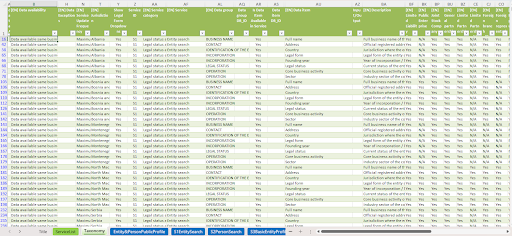
Figure 6. Sample data dictionary: BIFIDEX
3.2 Technological perspective: Making it work in practice
Beyond deciding what information is shared with whom to enable specific use cases, designing effective BO registers to support policy goals also requires understanding how data users need to access and process this information. Here, technology plays a central role.
The technological perspective examines how infrastructure can enable the practical use of interoperable BO data across borders. Taskforce discussions highlighted that technology is not an end in itself, but rather a means to operationalise semantic alignment and governance agreements through technologies such as reliable identifiers, machine-readable data, well-documented APIs, and secure access mechanisms. This perspective focuses on the foundational technical components required to connect systems in a federated manner, allowing data to remain managed at source while being discoverable, accessible, and usable by authorised users for defined purposes.
3.2.1 Challenges identified through Taskforce work
- Lack of machine-readable data made available to many source registries: Even for data users within government agencies, there is very limited access to machine-readable BO data from non-domestic registries.
- Unstructured data formats, making it difficult for systems to automatically interpret information. Taskforce members have stated that data services providers and analytical firms spend substantial time cleaning BO data from multiple jurisdictions. Better source data would allow them to focus on value-added tools and analytics instead of data wrangling. [13]
- Limited technological capacity in some contexts: Taskforce members emphasised the need for technical support to strengthen approaches to metadata, identifiers, and provision of bulk/API access in order to deliver technological interoperability.
- Entity resolution: Data users spend significant time resolving and connecting data from different sources and experience significant challenges with entity resolution.
“The biggest challenges to achieving interoperable BO data lie in the fragmentation and inconsistency of registry systems across jurisdictions. These include major disparities in technical access (from modern REST [Representational State Transfer] APIs to PDF-only registries), the absence of standardised identifiers, and highly variable data quality, especially in free-text shareholder and BO declarations. Semantic inconsistencies – such as different definitions of ownership, control, and even basic company status fields – further complicate cross-border data mapping. Existing APIs and bulk data are often poorly documented, unreliable, or legally restricted, creating high integration costs and operational delays. Finally, limited access to BO registers following legal changes, combined with weak verification in many jurisdictions, forces reliance on indirect ownership inference and undermines confidence in the source data.”
– Steve Lamb, CEO Kyckr
3.2.2 Core technical enablers
The following were identified by Taskforce members and existing research as core enablers of interoperable BO data.
- Machine-readable access: The availability of BO data in machine-readable formats, such as through APIs, bulk exports, and in structured formats (e.g. JSON, XML) is important for enabling efficient data sharing and analysis, particularly at scale.
- Standardised data schemas: Technical data standards such as BODS offer a common technical format through which specific fields of semantically aligned information can be shared, exchanged, analysed, and combined.
- Entity resolution tools: Probabilistic and graph-based algorithms that can link ownership data across systems are key to many existing initiatives that aggregate and analyse large datasets, including BO information. Private sector platforms, including those in which Taskforce members are involved, already demonstrate large-scale entity reconciliation and analytics – proving that interoperability of datasets spanning multiple jurisdictions can be effectively operationalised. These tools are particularly valuable given the lack of ubiquitous use of consistent identifiers.
- Provenance metadata: Users find value in metadata that includes key information about BO records, such as who submitted it, as well as when and how it was verified.
- Privacy and access control: Technologies are critical to authenticate registered users of non-public information and control secure access, allowing transparency without breaching personal data protection laws.
Case study 4: Approach to technological interoperability in the Business Registers Interconnection System and the Business and Financial and Data Exchange
In BRIS, technological success has been anchored in the European Core Platform (ECP), which has served as a neutral interoperability layer enabling secure, structured data exchange between national registers, without centralising their databases. The use of standardised message formats, shared identifiers (EUID), and harmonised service protocols has ensured that information can flow reliably while each registry maintains its own system and sovereignty. This architecture has proven to be both scalable and resilient – capable of integrating new member states and adapting to evolving legal requirements without major redesigns.
BIFIDEX, though regionally implemented and technically simpler, has reinforced similar principles through a more lightweight technological setup. A central access layer indexes data from national sources using standard APIs and controlled vocabularies, allowing users to query multiple registries seamlessly. The project has shown that interoperability can be achieved incrementally by connecting existing systems through shared metadata and common identifiers rather than overhauling legacy infrastructure.
Together, BRIS and BIFIDEX highlight three key technological success factors for the Taskforce to consider:
- Neutral architecture: Interoperability built on a federated model that connects, rather than replaces, national systems.
- Standardisation and identifiers: Consistent data formats, APIs, and unique identifiers that ensure traceability and cross-border consistency.
- Scalability and modularity: The ability to evolve incrementally allowing new participants or data domains to be integrated without disruption.
3.2.3 Existing initiatives relying on structured data formats and standards
Experience from existing cross-border data initiatives demonstrates that structured, standardised data formats are a critical technical enabler of interoperability, particularly when data must be exchanged or reused across jurisdictions with different legal and institutional settings. These initiatives succeed not because they centralise data, but rather because they establish common technical specifications that allow systems to “speak the same language”, while remaining nationally operated.
A prominent example is the OECD’s Automatic Exchange of Information (AEOI) under the Common Reporting Standard (CRS). CRS prescribes a detailed, machine-readable schema defining data elements, formats, identifiers, and validation rules, enabling tax authorities to exchange large volumes of financial account information securely and at scale. While CRS serves a distinct policy objective – that is, to combat tax evasion by enabling the sharing of information related to bank accounts held overseas by the citizens of participating countries – it illustrates how clear data models, controlled vocabularies, and agreed data exchange formats can support routine, reliable cross-border exchange without harmonising underlying domestic systems. This experience was frequently referenced by Taskforce members as proof that technical interoperability is achievable when sufficient semantic and governance foundations are in place.
In the BO domain, BODS represents the most mature and relevant example of a structured data format designed explicitly to support interoperability. BODS provides a common model for describing entities, people, ownership interests, and control relationships, enabling data from different registers to be linked and analysed. Countries such as Armenia and Latvia have demonstrated that publishing BO data in BODS format allows downstream users to combine datasets more efficiently, even when legal definitions and disclosure thresholds differ. Taskforce discussions emphasised that BODS is not a complete solution on its own, but a foundational, technical building block that can underpin multiple interoperability scenarios, from standardised access to register-to-register exchange.
At the regional level, the EU AML framework further illustrates the growing policy expectation that technical standardisation is necessary for effective BO data use. Recent AML legislation mandates the European Commission to prescribe a common format for the collection and transmission of BO information, laying the groundwork for technical alignment across member states. While implementation is still evolving, this approach signals a shift from high-level policy requirements toward operational technical specifications, an evolution that Taskforce members identified as essential for moving from transparency in principle to interoperability in practice.
Taken together, these initiatives show that structured data standards can substantially reduce friction in cross-border data use. However, Taskforce discussions also noted that their impact depends on adoption, data quality, and integration into real user workflows, reinforcing the need to pair technical standards with semantic clarity and sustained governance arrangements in future BO interoperability efforts.
3.2.4 Facilitating data access: API and bulk data availability
Across Taskforce discussions, there was strong consensus that interoperability is only meaningful if BO data can be accessed in practice. APIs and bulk data access emerged as the two core technical mechanisms through which interoperable BO data can be operationalised, serving distinct but complementary use cases.
APIs are well suited to operational and time-sensitive use cases, including compliance checks, supervisory workflows, investigative queries, and cross-system verification. They enable real-time, system-to-system interaction, incremental updates, and controlled access in federated environments where data remains managed at source.
Several BO registers and related government datasets provide APIs that allow authorised users to query ownership information directly from the source system. Taskforce interviews highlighted that developer-friendly documentation and version control are often decisive factors in whether such APIs are used in practice. Well-documented APIs reduce reliance on intermediaries and enable public and private users alike to integrate BO data into existing compliance and investigative tools. Conversely, poor documentation, opaque authentication, or inconsistent behaviour significantly increase integration costs and undermine trust.
Bulk data access plays a critical role in enabling large-scale analysis, network mapping, historical assessments, and the development of analytical or AI-assisted tools. Bulk access allows users to understand ownership patterns across jurisdictions and over time – capabilities that cannot realistically be replicated through API queries alone. Taskforce members and data services providers noted that bulk data is essential for training analytical models and supporting complex ownership mapping, particularly where ownership structures span multiple jurisdictions. Several Taskforce members noted that the absence of bulk data often leads users to reconstruct datasets through scraping or repeated queries, resulting in inefficiencies and reduced data reliability. However, Taskforce members noted the relevance of privacy and data protection considerations with providing personal data in a bulk format.
From an interoperability perspective, APIs and bulk data are most effective when provided together, with clear guidance on intended use cases. This layered access approach supports both operational needs and advanced analytics, while reducing duplication of effort and unnecessary system load.
Despite their central role, APIs and bulk data access remain uneven across jurisdictions. Differences in access rules, pricing models, and authentication requirements currently constrain cross-border usability of BO data. Taskforce members cautioned that restrictive or inconsistent access conditions can undermine interoperability objectives, even where technical interfaces exist.
The importance of APIs and bulk data in enabling interoperability
Private intermediaries consistently stress the importance of API access and bulk data for building integrated and scalable products. These features allow intermediaries to ingest large volumes of structured BO data and update their systems efficiently. [14]
API and bulk access facilitate end-to-end data operations through:
- Mapping and ingestion: APIs enable automated retrieval of structured data, reducing manual scraping and error-prone parsing.
- Cross-referencing: Bulk data allows cross-dataset joining and comparisons at scale.
- Timeliness: System-to-system access supports updates and synchronisation with source registers.
For example, Transparency International’s analysis of French BO and real-estate ownership illustrates the burdens associated with a lack of bulk access: investigators spent weeks retrieving and linking millions of web pages because bulk and API access were absent. [15]
In interviews with Taskforce members, data services providers emphasised that APIs and bulk data are foundational to intermediary services because they allow consistent ingestion into normalised platforms, a critical prerequisite for any interoperability model that leverages machine-to-machine connectivity.
Overall, the Taskforce’s findings underline that facilitating data access is not a purely technical exercise, but one that sits at the intersection of technology, governance, and user needs. Aligning APIs and bulk data access with clear use cases, common specifications, and sustainable governance arrangements is essential if interoperable BO data is to translate into meaningful impact in the fight against corruption, money laundering, and financial crime.
“API-driven, standardized access and proprietary UBO [ultimate beneficial owner] algorithms can enhance due diligence and AML efforts. However, persistent issues, particularly data cost, multilingual complexity, and limited cross-border cooperation, remain key barriers to global BO interoperability.” – Ficoal Dong, AsiaVerify
3.2.5 Data vendors’ practices: Mapping, scraping, cleaning, and value-added analytics
In the current ecosystem, many users of BO data depend on commercial and third-party intermediaries to bridge gaps in access, structure, and usability, with these actors facilitating technical interoperability between BO data from multiple sources and other relevant datasets. These vendors and data service providers put significant effort into mapping, scraping, cleaning, and augmenting BO information from national BO registers and other sources to produce consolidated datasets that can be integrated into compliance, investigative, and analytic workflows.
Their practices, including those shared through the direct experiences of Taskforce members, provide practical insights into the technical challenges of BO interoperability as well as examples of approaches that can inform future public-sector interoperability models.
The role of data services providers
Data vendors play a critical role not only in bridging gaps in BO and related corporate data, but also in generating added value through advanced data analysis and intelligence. They typically aggregate BO information from multiple national registers and complementary sources – such as company registries, sanctions and PEP lists, trade data, and, in some cases, open‑source and social media content – and transform this information into curated, structured, and enriched datasets for end users.
Industry research shows that while most BO service providers source data from official public registers, they rarely distribute it in raw form. Instead, they standardise and structure data into machine‑readable fields, enrich it with additional attributes, and link it across datasets to create more comprehensive and actionable intelligence for clients such as banks, law firms, and compliance platforms. [16] This analytical processing layer turns fragmented disclosure into usable insight rather than merely repackaged information.
Beyond addressing technical barriers, such as incomplete or unstandardised fields, inconsistent formats, and uneven data capture across jurisdictions, vendors actively enhance the underlying data. They apply entity resolution and network‑mapping techniques; reconcile multiple references to the same individual or legal entity; identify ownership hierarchies and control relationships; and flag potential risks or anomalies. In doing so, they convert disparate data points into coherent ownership views and risk‑relevant intelligence.
This combination of aggregation, enrichment, and analytical capability explains why many users are willing to pay subscription fees or licensing costs for vendor‑provided datasets. Rather than relying solely on national source registers, users benefit from a value‑added layer that improves reliability, usability, and insight. This supports more efficient due diligence, stronger risk assessment, and more informed commercial and compliance decisions.
Entity resolution and reconciliation approaches
A core technical challenge for vendors is entity resolution – determining that records from distinct sources refer to the same real-world entity. This is equivalent to record linkage in information science, where data matching is required despite variability in formats, missing identifiers, or ambiguous names.
In practice, vendors apply a range of techniques to do this, including:
- Identifier prioritisation: Where reliable identifiers are available (e.g. company registration numbers, LEIs), they serve as the primary way to link records, dramatically increasing matching accuracy.
- Attribute enrichment: Additional attributes – such as full names, DOBs, and nationalities – are used to disambiguate records when unique identifiers are absent.
- Graph analytics: Some vendors integrate multiple datasets into network graphs that reveal hidden relationships across ownership structures. [17]
- AI-assisted reconciliation: Vendors are increasingly leveraging AI to learn entity patterns and generate probabilistic matches from historical data. Under frameworks of strong governance and transparent provenance, vendors identify strong potential for AI to accelerate reconciliation, though vendors caution that internal documentation and human supervision remain essential to prevent spurious links and “hallucinations” common in generic generative models.
Enhancing usability of data through analytics tools
Beyond data consolidation, vendors offer analytical tools that add interpretive or visual layers to interoperable data. These include:
- Ownership network visualisers, which display entity–person linkages once data is reconciled across sources. For example, Open Ownership’s BODS data visualiser tooling demonstrates how structured BO data can yield interactive views of ownership chains. [18]
- Risk indicators and screening modules, which integrate BO with sanctions, PEP, or adverse news datasets, offering compliance insights beyond raw registry data.
- Historical trend tools, which allow users to track changes over time. Vendors often build these by ingesting and retaining bulk snapshots of register data (e.g. for governance reporting or due diligence).
These practices reinforce that technical interoperability is grounded in well-structured, accessible data, and underscore the value of solid technical foundations for flexible and impactful use of BO data, such as through APIs and identifiers.
3.2.6 Enabling responsible and secure use of interoperable beneficial ownership data: Leveraging emerging technology
As interoperability of BO data advances, how data is accessed and used becomes as important as how it is technically connected. Taskforce discussions highlighted a set of considerations that sit at the boundary between technology, legal safeguards, and governance, which must be addressed to ensure that interoperability delivers public value without creating new risks.
A central principle is responsible use by design. Interoperable BO systems should be developed to support clearly defined purposes – such as AML/CFT supervision, investigations, and compliance – while preventing misuse of sensitive information. This requires technical controls that operationalise policy decisions, including purpose limitation, proportionality, and accountability.
Layered access models emerged as a particularly important enabling mechanism. Rather than a binary “open vs. closed” approach, interoperable BO infrastructures can provide differentiated access based on user type and purpose. For example, supervisory authorities may require granular, near-real-time access via APIs, while other users may access more limited datasets or derived information. Technically, this implies role-based access control, tiered datasets, and configurable disclosure rules, while governance arrangements determine who qualifies for which level of access and under what conditions.
Cybersecurity and authentication mechanisms are foundational to sustaining trust in interoperable systems. Secure identity management for both users and systems, including strong authentication, authorisation protocols, logging, and audit trails, were repeatedly identified by Taskforce members as a prerequisite for cross-border data exchange. Weak security at any single node risks undermining the credibility of the entire interoperability network.
BO systems handle personal information about the natural persons who ultimately own or control legal entities. These systems must comply with international and national regulations, such as the EU General Data Protection Regulation (GDPR), ensuring that personal data is appropriately protected (e.g. through encryption and access-controls). Role-based access, multi-factor authentication, and detailed audit logs were identified as useful tools to prevent unauthorised access and maintain accountability. Equally important is data integrity: cryptographic measures, automated validation, and reconciliation with other registries help ensure that BO records are accurate and reliable.
From a broader system perspective, the work of the Taskforce suggested that BO registries should leverage recognised cybersecurity frameworks like ISO/IEC 27001 and ISO 27002, NIS2 Directive, NIST CSF, and CIS Controls, covering network security, secure API design, and endpoint protection. [19] Similarly, interoperability mechanisms should leverage encrypted channels and secure authentication protocols as required. Continuous monitoring, incident response planning, and regular audits are crucial for detecting anomalies and mitigating breaches. Overall, a secure BO system combines robust technical safeguards, regulatory compliance, and operational governance to protect sensitive ownership data while enabling trusted data-sharing.
Finally, Taskforce discussions emphasised the importance of clear and enforceable use terms for the data that is made available to users, supported by technical monitoring and auditability. Usage conditions – including parameters around access, attribution, and responsible use – could be supported through technical mechanisms such as access tokens, rate limiting, and traceable queries. Rather than restricting onward sharing or commercialisation outright, these measures can be designed to enable controlled redistribution and value‑added commercial use of BO data while preserving transparency, data integrity, and accountability. Such approaches require clear governance frameworks to ensure that rules are consistently defined, overseen, and enforced across jurisdictions.
These considerations illustrate that responsible use of interoperable BO data lies at the intersection of technology and governance. While technical mechanisms can enable layered access, security, and traceability, credible governance frameworks are essential to set the rules, manage risks, and maintain trust over time.
3.2.7 Emerging technologies
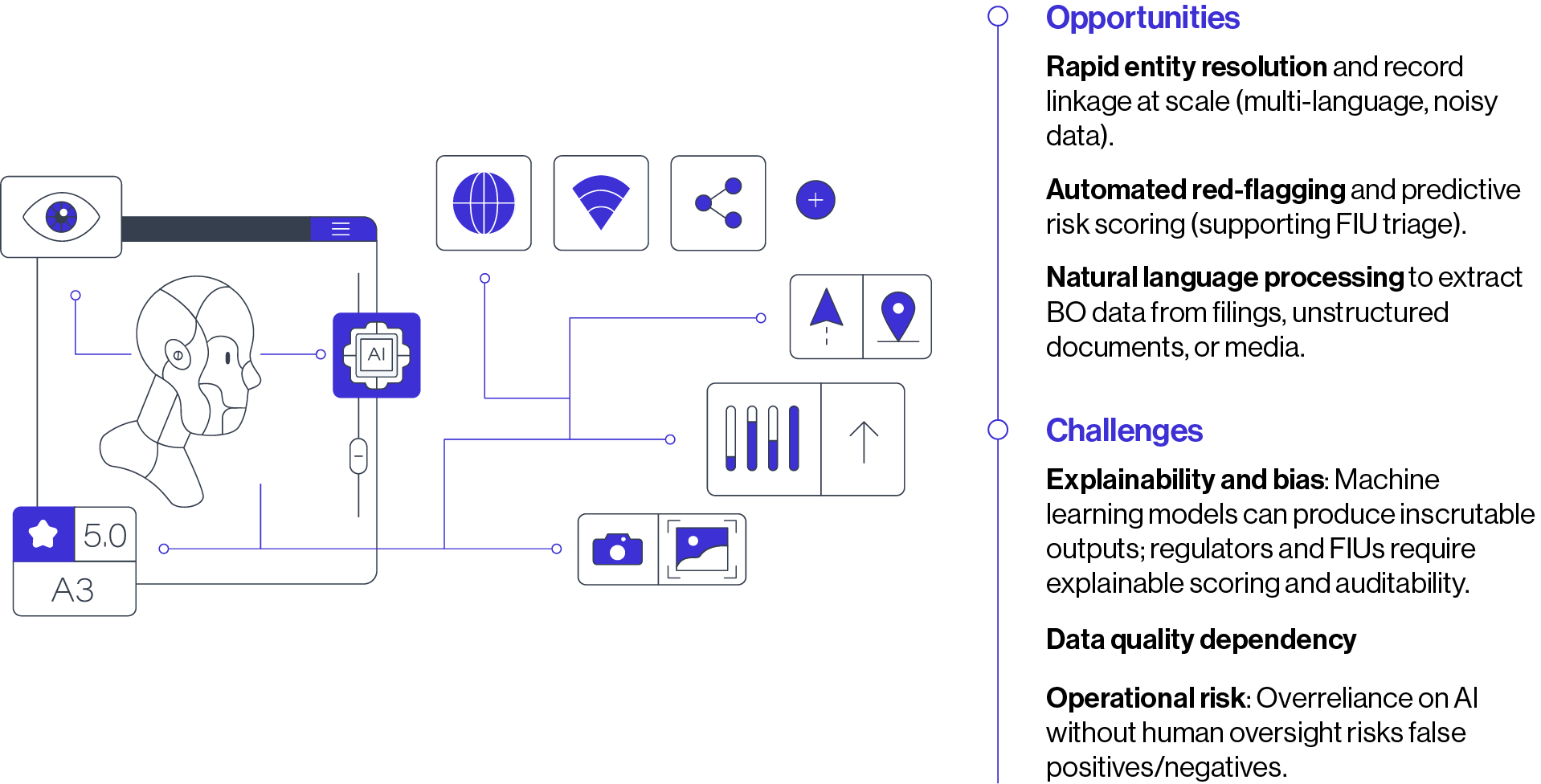
AI was highlighted by Taskforce members as a powerful enabler for key challenges such as entity resolution, helping match companies and individuals across fragmented datasets through probabilistic modelling, fuzzy matching, and pattern recognition. AI can assist in anomaly detection, identifying unusual ownership structures, circular control chains, or sudden changes in filings that may signal concealment or illicit activity. Natural language processing models can extract ownership information from unstructured documents (e.g. PDFs, registry filings, corporate disclosures), filling gaps where structured BO datasets do not exist.
Analytical method definitions
- Probabilistic Modelling
Uses statistical logic to calculate the likelihood that two records refer to the same entity. It accounts for uncertainty and missing data. - Fuzzy Matching
A technique used to identify strings of text that are similar but not identical. It catches “near misses” caused by typos, different spellings (e.g. “Jon” vs. “John”), or abbreviations. - Pattern Recognition
The ability of an algorithm to identify regularities or “shapes” in data. In this context, it refers to spotting complex webs of ownership or specific sequences of behavior that humans might miss.
Members have highlighted that AI systems used for BO analysis must be explainable, transparent, and human-supervised, especially when determining ownership and control thresholds with regulatory consequences.
AI could support the creation of a global semantic layer, assisting activities such as mapping heterogeneous national terminologies and legal definitions to a harmonised vocabulary (e.g. mapping local company types or control terms to common standards like BODS). Machine-learning could also help predict missing links in ownership chains by analysing historical registries, corporate networks, and patterns of nominee or layered structures.
Figure 7. The role of artificial intelligence
DLT has been identified as a means to create tamper-evident audit trails, ensuring that any update to BO data is recorded immutably for verification and accountability purposes. DLT could support cross-border verification proofs, allowing jurisdictions to validate that BO data comes from an authorised source without sharing the underlying personal data (“zero-knowledge proofs” or hashed attestations). Permissioned ledgers could facilitate secure inter-agency collaboration, where regulators and FIUs exchange verified BO claims while maintaining strict access controls. There is an opportunity to align with EU GDPR and increasingly robust global privacy requirements by not storing any personal data on-chain, and using only hashes, signatures, or attestations. DLT may also enable traceable provenance of BO filings, making it possible to see which authority or entity issued, verified, or amended each ownership statement. Smart contracts could enforce automated validation rules, such as completeness checks, update-frequency requirements, or cross-registry consistency checks.
These emerging technologies can serve as force multipliers, improving data quality, assurance, and analytical value once semantic, governance, and technical frameworks are in place. However, the work of the Taskforce suggests clearly that emerging technologies should not be the sole focus of efforts to deliver interoperability, but where good semantic, governance, and technical foundations are in place they can be leveraged to effectively support interoperability.
Figure 8. Possible application of distributed ledger technology
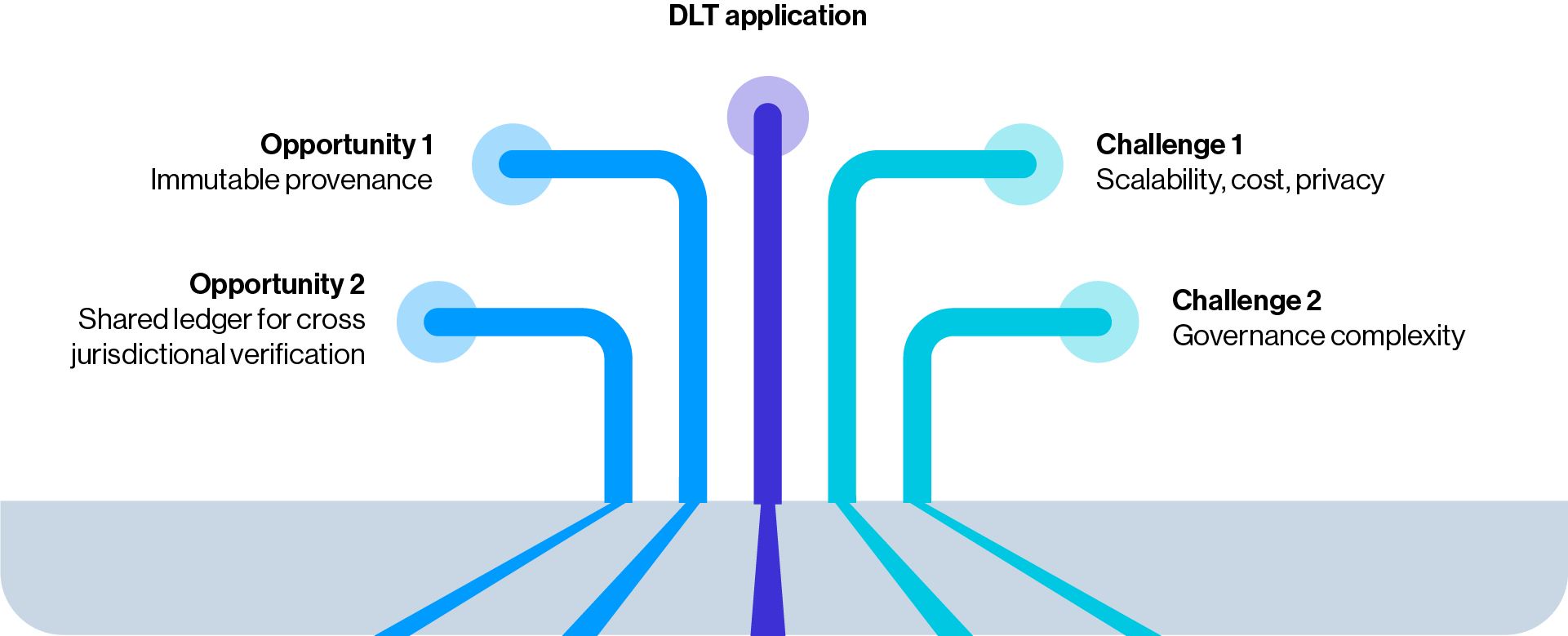
“DLT could facilitate secure cross-border data exchange due to its immutability and traceability, though adoption would require a strong business case and regulatory alignment. Existing crypto ‘travel rule’ networks already use similar models for secure data sharing.” – Taskforce member
3.3 Governance perspective: Building trust and stewardship
Interoperability is fundamentally a governance challenge. Even where data standards align and technical connections exist, interoperability will not be sustained without institutions that are willing and able to cooperate, trust each other’s data, and jointly steward shared mechanisms over time. This section focuses on the institutional arrangements, collaborative models, and accountability frameworks required to make interoperability durable, credible, and scalable.
Operationalising interoperability requires governance structures that can set common rules, manage risks, and clarify the balance between national autonomy and collective goals. These structures must support coordination across jurisdictions, provide clarity on roles and responsibilities, and ensure that interoperability initiatives remain aligned with public interest objectives, such as AML/CFT effectiveness, data protection, and responsible use. Crucially, governance is also the mechanism through which semantic and technological choices are legitimised, adopted, enforced, and scaled, transforming technical possibilities into trusted, operational systems.
3.3.1 Challenges identified through Taskforce work
The Taskforce’s work highlighted a set of structural governance challenges that currently limit the scalability and sustainability of BO interoperability initiatives. These challenges are not confined to any single jurisdiction or initiative. Rather, they reflect broader fragmentation in the international governance landscape for BOT and data use.
The first challenge is fragmented international governance. Multiple international initiatives and standards relevant to BO data exist, often aligned to specific policy domains, such as the OECD’s AEOI and Exchange of Information on Request (EOIR) in the tax domain, and FATF Recommendations in the AML/CFT context. While each plays an important role, their mandates, timelines, and institutional homes are not fully aligned, since they are set up to achieve different purposes. This fragmentation creates uncertainty for implementing agencies, complicates prioritisation, and weakens incentives to invest in interoperability solutions that cut across policy silos.
Secondly, the Taskforce identified limited coordination between BO registries and key data users, both domestically and internationally. In many jurisdictions, the operation of BO registers is carried out largely in the absence of regular and structured input from those who rely most heavily on the information. This includes public authorities such as FIUs, tax authorities, procurement bodies, and law enforcement agencies, as well as financial institutions, which are among the largest and most frequent users of BO information. Banks and other obliged entities rely on ownership data extensively to conduct customer due diligence, sanctions screening, and ongoing risk monitoring under AML/CFT frameworks. However, in many jurisdictions they are not legally permitted to rely solely on information from BO registers for compliance purposes, and must independently verify ownership information.
For instance, the Wolfsberg Group – an association of 12 banks that develops frameworks and guidance for the management of financial crime risks – indicates that information from company registries and other reputable public sources may be used to corroborate customer due diligence information, with the extent of corroboration determined by a risk-based approach. [20] This reduces the practical utility of registers for some of their primary users, and reflects broader governance challenges related to trust, verification, and liability. The disconnect between registries and users is magnified at the cross-border level, where there are few established channels for systematic engagement with data users in other jurisdictions to inform how and what information is provided by registrars. As a result, interoperability efforts risk being supply-driven rather than grounded in concrete user needs and operational realities.
Thirdly, political sensitivities and data protection concerns continue to hinder data-sharing, even between trusted partners. Taskforce members noted that uncertainty around privacy obligations, fear of misusing BO data, and differing national approaches to BO data access can lead to conservative access policies or reluctance to participate in joint initiatives. While these concerns are legitimate, the work of the Taskforce highlights that it is the absence of trusted governance arrangements, rather than technical impossibility, which is often the underlying barrier. Without clear rules, safeguards, and accountability mechanisms, institutions can be incentivised to prioritise risk avoidance over collaboration.
Together, these challenges underscore why governance must be treated as a core pillar of BO interoperability. Addressing fragmentation, strengthening coordination with data users, and building trust around responsible data use are essential preconditions for translating semantic and technological advances into meaningful cross-border impact.
3.3.2 Existing initiatives and approaches
A number of international, regional, and sector-specific initiatives already address aspects of BOT, data exchange, and cross-border cooperation. The initiatives outlined below provide important building blocks and lessons for BO interoperability, particularly in relation to governance coordination, trust-building, and accountability. At the same time, they reveal gaps and constraints that help explain why BO interoperability remains fragmented and uneven globally.
Table 4. Mapping of existing initiatives, approaches, and limitations
| Initiative | Solutions and approach | Challenges and limitations |
|---|---|---|
| FATF Standards and Mutual Evaluation Process | Sets global AML/CFT standards, including BOT requirements; peer review and evaluation mechanism drives national reforms. | Does not prescribe technical interoperability models; limited guidance on cross-border BO data use beyond cooperation principles. |
| OECD AEOI/CRS and EOIR | Highly structured, standardised cross-border exchange of tax-related information; strong governance via Global Forum peer reviews. | Designed for tax purposes; data on bank account ownership not BO of legal vehicles; heavily restricted access to tax authorities; regular point-in-time exchange not live/up-to-date data; high legal and operational barriers limit implementation of AEOI, particularly for lower-income countries. |
| Sectoral initiatives (e.g. EITI, CoST – Infrastructure Transparency Initiative) | Disclosure requirements and transparency norms in specific sectors; broad coverage (e.g. more than 50 EITI implementing countries); encourages or mandates BO reporting for companies operating within the sector. | Sector-specific; BO disclosure requirements vary; not designed for register-level interoperability or data exchange. |
| EU’s Beneficial Ownership Registers Interconnection System (BORIS) | Federated interconnection of national BO registers via a single EU access point; supported by EU AML legislation. | Limited to EU/European Economic Area context; uneven implementation and data quality; access restrictions vary widely; does not currently facilitate combining data from different source registers. |
| BRIS | EU-wide governance and technical framework for interconnecting business registers; common specifications and institutional stewardship. | Not focused on BO data; semantic harmonisation is partial; governance model does not fully translate to non-EU or BO-specific contexts. |
| World Bank BOT Thematic Working Group | Facilitates knowledge-sharing and visibility of policy research, as well as country implementation of BO reforms; convenes global and regional actors. | Outputs are advisory rather than operational; no specific focus or mandate on interoperability or international BO data-sharing. |
| G20 High-Level Principles on BOT | Political commitment to BOT and international cooperation. | High-level and non-binding; no operational governance or technical prescriptions. |
| Regional networks (e.g. Africa Beneficial Ownership Transparency Network (AfBOT Network)) | Regional dialogue and peer-learning on BO reforms; supports alignment of national practices. | Interoperability is implicit rather than a core objective; limited technical and institutional capacity to convert dialogue into sustained efforts to promote data exchange. |
| LEI-BO integration initiatives (GLEIF, Open Ownership) | Promotes use of global identifiers to link BO data with other datasets; improves semantic consistency. | Adoption remains uneven; identifiers alone do not create governance or exchange mechanisms. |
Taken together, these initiatives demonstrate that trusted international data-sharing on BO information is feasible, particularly where there is a strong policy mandate, clear institutional leadership, and agreed rules. However, the Taskforce’s review of these efforts shows that most were not designed explicitly to support interoperable BO registers across multiple jurisdictions and use cases.
Limitations across initiatives
Across these initiatives, several recurring limitations emerged:
- Fragmented mandates: Governance responsibilities are dispersed across institutions with different policy objectives (e.g. tax, AML, corporate transparency), resulting in limited alignment and coordination.
- Sector- and purpose-specific design: Most initiatives are tailored to a single use case or authority type, constraining their applicability to broader BO interoperability.
- Limited operational stewardship: Few initiatives provide end-to-end governance covering semantic alignment, access rules, technical exchange, and accountability over time.
- Geographic constraints: Regional models (e.g. EU systems) demonstrate what is possible under strong legal alignment but are difficult to scale globally.
- Access and trust barriers: Legal uncertainty, privacy concerns, and uneven trust between institutions continue to inhibit data-sharing, even where technical solutions exist.
These limitations help explain why, despite significant progress on BOT, interoperability remains partial and fragile. They also underline the need for governance models that explicitly focus on stewardship of interoperable BO data, building on existing initiatives while addressing their gaps. The following sections explore emerging governance models that could support progress.
3.3.3 Role of global policy frameworks in encouraging good source data at the national level
Global policy instruments and frameworks play a pivotal role in shaping national legal frameworks for BOT by encouraging countries to adopt effective BO registers. These national (or in some cases, such as in certain federated countries, subnational) registers are the foundational building blocks of international data exchange and interoperability. By setting normative expectations, providing interpretive guidance, and creating standards against which implementation can be measured, these instruments help align domestic BOT reforms with the needs of cross-border data use without prescribing rigid technical solutions.
A recurring insight from Taskforce deliberations and Open Ownership’s legislative guidance is that the law itself should facilitate access and usability for diverse data users – not merely require disclosure within a narrow domestic context. Global policy instruments have encouraged jurisdictions to adopt BO laws and registers that provide timely, accurate, and accessible information. For example:
- The FATF Standards explicitly require that BO information be available to domestic authorities, financial institutions, and other obliged entities (Recommendation 24), which has influenced national laws to go beyond closed registries. [21]
- UNCAC and subsequent Resolutions 9/7 and 10/6 encourage member states to establish and maintain adequate and up-to-date information on BO of legal vehicles, and to support use of this information for the prevention, deterrence, and detection of corruption and to assist asset recovery. [22]
- The Compromiso de Sevilla outcome document of the 4th UN Financing for Development Summit calls upon signatory countries to advance BOT to combat IFFs, including through implementing effective domestic BO registries, enhancing information exchange, and exploring the feasibility and utility of a global BO registry. [23]
- The G20 High-Level Principles on BOT (2014), call for effective mechanisms for international cooperation. This has encouraged countries to consider how their BO frameworks support legitimate cross-border use. [24]
As recognised within these global policy frameworks, effective BOT implementation goes beyond establishing national registers: it encompasses accuracy, completeness, timeliness, and reliability of BO data, as well as giving data users the ability to access and exchange information for specific purposes. Poor-quality data undermines both domestic compliance and cross-border interoperability; no amount of technical integration can compensate for inaccuracies or gaps in source registers.
For example, the FATF’s guidance and mutual evaluation processes emphasise the importance of verifying BO information, recommending that countries have processes to ensure submitted information is accurate and up to date.
By tying legal obligations to effectiveness and outcomes, these frameworks promote an environment in which semantic and technical alignment becomes feasible. When data in national registers is accurate, up to date, and of good quality, these registers can more reliably feed into regional and global interoperability layers.
Global policy instruments generally avoid rigid prescriptions on technology, instead promoting principles that encourage good practice. This balance is necessary: laws that dictate specific formats or platforms risk premature obsolescence or rigidity, whereas principles focused on data access, structure, and quality allow technical implementers to innovate while staying consistent with interoperability objectives.
For example, neither the FATF standards nor UNCAC Resolution 10/6 specify API requirements; instead, they stress the timely availability of accurate information to relevant users. This creates a policy basis upon which machine-readability, standardised formats (e.g. BODS), and API access can be developed in ways that honour both legal safeguards and interoperability goals.
3.3.4 Regional and sub-regional collaboration initiatives
As the Taskforce’s work has emphasised, the translation of interoperability concepts into practice requires more than technical standards and semantic alignment, it demands legal frameworks with clear obligations and enforcement mechanisms, supported by dedicated institutions with the authority and capacity to implement and oversee them. Where such frameworks exist, they provide clarity on responsibilities, access rights, and compliance expectations, helping to align domestic implementation with broader cross-border interoperability goals.
Anti-money laundering in the European Union and relevant legal obligations for beneficial ownership registers
The EU’s evolving AML architecture provides one of the most advanced examples of how legal frameworks can shape central registers and, by extension, interoperability foundations. AMLD6 and the accompanying AMLR create mandatory legal obligations for member states to establish, maintain, and interconnect central BO registers with harmonised standards for data collection, verification, and access. Under AMLD6, national BO registers must be digital, machine-readable, and interconnected via systems such as BORIS, enabling competent authorities and obliged entities to query BO information across the EU.
Specifically, AMLD6 requires member states to provide immediate, unfiltered access to BO information for competent authorities, supervisors, obliged entities, and entities with legitimate interest, such as AML data providers, which should have timely access for AML/CFT purposes. Member states must also establish harmonised search criteria to support efficient queries across registers. The directive also strengthens central registers by enhancing data-quality obligations, including verification powers for registrars to ensure accuracy and completeness of submitted BO data. These provisions strengthen legal duties for both reporting entities and authorities, while advancing a governance model where enforcement and oversight by national authorities and EU agencies (including the Anti-Money Laundering Authority) support implementation.
BORIS, established by a Commission Implementing Regulation, integrates national central registers to enable cross-border access – showing how a legally mandated infrastructure can combine semantic, technological, and governance functions. Through such legal frameworks, interoperability is not an optional technical goal but a compulsory aspect of domestic AML/CFT compliance regimes, with institutional actors tasked explicitly with enforcement and coordination.
Limitations: Uneven institutional anchoring across regions
Despite the sophistication of the EU model, significant limitations remain. These illustrate why not all regions are similarly positioned to operationalise interoperability through binding law and institutions.
Legal obligations are only effective if properly implemented. Several member states missed the transposition deadlines for AMLD6, which amended AMLD4/5 provisions on access to BO information. These delays – particularly those regarding timely access for competent authorities, obliged entities, entities with legitimate interest, and certain non-national users – have led the European Commission to initiate infringement proceedings under Article 258 of the Treaty on the Functioning of the European Union. [25]
Access conditions to BO registers differ in practice across member states, particularly for non‑national users. Some countries impose restrictive authentication requirements, such as national e‑ID schemes, while others limit access through a legitimate interest assessment, which is applied inconsistently. [26] These divergences affect the ability of obliged entities, competent authorities, and other stakeholders to obtain timely BO information, as required under AMLD6 (amending AMLD4/5, Articles 30–31). [27]
Beyond the EU, BO register design and access rights are generally codified only in domestic law without explicit provisions for cross-border use or higher-level enforcement mechanisms. The absence of regional bodies with binding authority, such as a regional AML supervisor or integrated judiciary, limits the ability to align legal obligations across borders and provide users with predictable access pathways. This is particularly acute in regions without strong AML/CFT supervisory ecosystems or where institutional capacity is low.
Smaller-scale legal and institutional pathways: Data-sharing agreements and networks
While comprehensive global or regional legal frameworks – such as the EU’s – are still being developed or adopted more widely, countries and institutions can already make use of smaller‑scale legal instruments to support interoperability.
Bilateral or multilateral data-sharing agreements, underpinned by Memoranda of Understanding (MoUs) or treaty-level commitments, can establish legally binding expectations for exchange of specific BO information between participating states. These agreements can define obligations for data quality, confidentiality, permitted uses, and technical standards for exchange, offering a narrow but enforceable governance space that respects domestic legal constraints while enabling cross-border cooperation.
Such data-sharing agreements have precedent in other domains. For example, the AEOI and EOIR frameworks are used for tax transparency, combining legal commitments with clear access and use regimes. Although tax exchange standards are sector-specific, they illustrate how legal instruments can define enforcement expectations and data access pathways between governments.
At a regional level, agreements between national BO registries, law enforcement agencies, and FIUs can also serve as a bridge toward broader interoperability. These smaller networks can develop standardised protocols, mutual recognition of verification processes, and technical interfaces within an agreed legal framework, thereby generating operational experience and confidence that can inform wider governance arrangements.
Inter-agency data sharing and collaboration initiatives
Cross-regional and sub-regional initiatives can also facilitate cooperation and information-sharing between trusted partners, often between specific agencies around a defined purpose. These include:
- Eurojust Joint Investigation Teams (JITs) bring judicial and law enforcement authorities from multiple EU states together for fixed periods under agreed legal frameworks, operationalising BO data use in transnational cases through trust-based, structured cooperation. Such mechanisms foster deep inter-agency and inter-jurisdictional familiarity and reduce friction in information exchange.
- The International Anti-Corruption Coordination Centre (IACCC) initiative – a voluntary police-to-police cooperation tied by MoUs – shows how smaller groups with strong relational trust can share intelligence and BO data more effectively than broad, impersonal networks. While limited in scale, these hubs highlight the importance of institutional trust and sustained engagement for interoperability. [28]
- BIFIDEX, developed by business registries in Albania, Bosnia and Herzegovina, Montenegro, North Macedonia, and Serbia, offers an instructive sub-regional example of how geographic proximity, economic integration, and political alignment can foster interoperability and trust. Its development has been supported by regional governments and international partners – for example, the European Bank for Reconstruction and Development (EBRD) – underscoring the synergy between shared economic interests and transparency goals that accelerates interoperability and creates an ecosystem where data can be trusted and harnessed for economic and regulatory benefits.
The above models underscore that trust, legal clarity, and common operating norms are as critical as the technical ability to exchange data.
Platforms, trust, and shared policy goals
The landscape of BO interoperability is shaped by multi-layered cooperation mechanisms.
- Global forums and standards bodies (Open Ownership, FATF, OECD, UN) provide normative guidance and common frameworks that incentivise interoperability and set expectations for data quality and exchange.
- Regional and sub-regional systems and networks (BORIS, AfBOT Network, East African Community, Economic Community of West African States, Common Market for Eastern and Southern Africa, Southern African Development Community) offer structured, policy-aligned platforms where adjacent countries can harmonise approaches, build trust, and operationalise technical solutions.
- Trust-based cooperative models (Eurojust JITs, IACCC MoUs) reveal that relationship networks and formal collaboration mechanisms greatly enhance the willingness and ability of authorities to share sensitive BO data meaningfully.
Together, these mechanisms form an ecosystem of cooperation and trust that is essential for achieving interoperability – turning national data silos into connected, usable, and trusted datasets that support anti-corruption, AML/CFT, asset recovery, and economic transparency goals worldwide.
Case study 5: Governance interoperability under the Business Registers Interconnection System and the Business and Financial Data Exchange – Lessons for a future beneficial ownership governance model
A defining feature of BRIS is that it achieved interoperability not by centralising authority, but by establishing a distributed governance model that ensured alignment, accountability, and trust among national registers. Each member state retained legal and operational control over its national business register, while agreeing to operate within a common governance framework coordinated by the European Commission. This framework defined roles, responsibilities, and procedures for maintaining data quality, managing identifiers, ensuring security, and implementing updates to shared specifications. The governance layer thus served as the glue that held the technical and semantic layers together, ensuring that interoperability was not only a matter of compatible systems, but also of consistent institutional behaviour.
The BIFIDEX initiative illustrates how governance design can become a critical vulnerability in cross-border interoperability projects when institutional ownership and accountability are not firmly anchored. Established as a regional technical platform without a permanent intergovernmental mandate (established as a non-incorporated joint venture), BIFIDEX has relied on voluntary coordination among national business registries, each operating under different legal and political frameworks. This loose arrangement left the initiative exposed to governance volatility: changes in national leadership, shifting political priorities, or the absence of a functioning management board, which periodically disrupted decision-making and funding.
The key lesson for the Taskforce is that interoperability cannot be sustained by technology alone – it requires a governance model backed by formal institutional commitments, predictable funding mechanisms, and stable leadership structures that can endure political cycles and safeguard the integrity of the shared infrastructure.
3.3.5 Sustainable funding as a foundation for operationalising interoperability
Sustainable funding is a critical enabler for bringing BO interoperability out of concept and into durable practice. The Taskforce identified funding insecurity as a central challenge that has hindered several interoperability efforts, especially regional initiatives that struggle to maintain infrastructure, governance bodies, and technical evolution beyond initial project lifecycles. Without reliable financing, even well-designed systems risk fragmentation, stalled expansion, or complete discontinuation when initial grants or political attention dissipate.
The BIFIDEX experience: Innovation, impact, and funding constraints
BIFIDEX illustrates both the promise of regional interoperability and the consequences of weak governance structures and sustainable funding.
The platform’s development was supported by a mix of funding sources, including the EBRD and initial project financing through grants. However, despite its technical success and uptake, BIFIDEX highlights the challenges of sustaining such infrastructure over time. Initial funding enabled development and launch, but long-term operation, marketing, and extension of services have been impeded by the absence of a stable, long-term financing model anchored in predictable public or regional allocations and service-level commitments. The joint pricing policy and public-private partnership model aimed to offset costs through commercial services, but due to the management board’s struggle to agree on a joint pricing policy it did not take off. This approach alone has proven insufficient to sustain comprehensive operations and governance structures at scale, illustrating how reliance on project funding, weak governance structures, and voluntary contributions undermines momentum.
Global and regional precedents for sustainable funding
Examples from other domains underscore the importance of sustainable financing paired with governance mandates.
- EU interoperability platforms: Systems such as BRIS are supported through EU budget lines and institutional frameworks that provide recurring funding and governance continuity. This ensures maintenance, onboarding of new members, and compliance with evolving legal requirements.
- Tax information exchange frameworks: Initiatives like the AEOI under the CRS rely on formalised global agreements and peer-review processes backed by OECD infrastructure and member contributions, which support ongoing governance and technical operations. This model illustrates how enforceable commitments and shared funding responsibilities underpin sustained cross-border data systems. However, the initial implementation costs associated with AEOI are frequently flagged by lower-income countries as a barrier to their participation in the initiative.
- Development finance frameworks: Regional facilities such as the Western Balkans Investment Framework combine grants, loans, and technical assistance packages pooled from the European Commission, EBRD, European Investment Bank, World Bank, and bilateral donors to finance infrastructure, digital governance, and capacity-building projects. Such pooled funding mechanisms can support interoperability initiatives when they are incorporated into broader development agendas.
- Public-private collaboration: Countries such as Denmark and the UK have designed access to their BO registries to create opportunities for actors in the private and non-profit sectors to reuse and integrate the data within commercial and public good products and services. This has proven to be a cost-effective way for governments to strengthen the quality of insights that users can derive from their data.
Cross-cutting challenges and considerations
Across global and regional contexts, several funding-related barriers affecting BO interoperability have surfaced through the Taskforce’s work. These include:
- Project versus programme financing: Many interoperability initiatives begin with time-bound project grants that enable development but do not transition to ongoing programme budgets for long-term operation, governance, and evolution.
- Lack of mandated cost-sharing: Without formal commitments from participating countries or institutions to contribute recurrent funding (e.g. through membership dues or budget appropriations), interoperability platforms may struggle to maintain staffing, infrastructure, and technical support.
- Competing priorities: Government agencies often face competing demands for constrained budgets. In resource-constrained periods, direct service delivery can be prioritised over interoperability infrastructure.
- Revenue model constraints: Commercialisation (e.g. through subscription models) can generate revenue, but creates equity and access concerns, particularly when data is meant to support public interest goals like AML/CFT compliance and investigative use.
- Perpetuation of fragmented international BOT architecture by siloed donor support: Donors, including multilateral development banks, perpetuate the fragmented international BOT architecture by supporting and developing stand-alone and disconnected systems. This is challenging to address, as most countries cannot invest in systems that are interoperable with others without this funder assistance, but the work continues to be carried out in isolation, and there is a distinct lack of donor coordination.
Towards financial sustainability
A sustainable funding strategy for BO interoperability needs to be multi-layered and tied to institutional mandates. The Taskforce identified the following elements to consider:
- Domestic public funding through national and regional budgets that reflect the public interest dimension of BO data access (e.g. AML/CFT enforcement, regulatory compliance, economic transparency).
- Pooled funding mechanisms that bring together development partners, regional institutions, and supranational bodies to share costs and risks.
- Cost-sharing agreements codified through MoUs or legal frameworks that articulate periodic contributions from participating jurisdictions.
- Balanced commercialisation where fee-based services augment but do not replace public-funded core interoperability functions.
- Donor alignment through increased communication and coordination between donors supporting BO interoperability.
The Taskforce’s work suggests that sustainable funding cannot be an afterthought. It must be integral to governance models and legal frameworks in order for interoperability infrastructures to transition from demonstration projects to enduring public utilities capable of serving diverse users across borders.
3.3.6 Emerging approaches to transnational governance for interoperability
Through the Taskforce’s exploration of pathways toward sustainable and trusted interoperability of BO data, a range of governance approaches are seen emerging from global and regional practice. These vary in their degree of centralisation and stakeholder participation but share a common aim – to ensure coherent oversight, accountability, and continuous improvement of the interoperability framework across jurisdictions. The following table outlines three possible governance approaches. These are not mutually exclusive, and can serve to guide future development of a transnational governance architecture for interoperable BO data.
Table 5. Possible governance approaches
| Approach | Attributes |
|---|---|
| Global consortium approach | A light coordination structure that brings together key global actors – e.g. FATF, United Nations Office on Drugs and Crime (UNODC), OECD – to act as custodians of interoperability principles and standards. This would require deepening or expanding the role of these actors to extend beyond setting broad policy standards and/or exchange protocols to meet specific use cases. |
| Regional nodes with global coordination or federated governance architecture | A decentralised approach where common operational and semantic standards are developed by countries working with regional or subregional agencies, guided by global policy alignment. |
| Public–private partnership approach | Increasing the mandate of private sector actors (e.g. banks and other regulated entities), and/or data services providers and civil society to contribute to data quality, analytics, and innovation to build infrastructure to process and connect data from multiple countries. This would require consistent access to BO information for these actors. |
3.4 Common pitfalls identified in existing interoperability initiatives
Based on Taskforce discussions, interviews, and case reflections across the three interoperability dimensions, certain approaches were identified as high risk or low impact when pursued as first steps toward BO interoperability. These insights are included here to assist actors in mitigating or avoiding known pitfalls.
- Launching a global platform without semantic and governance foundations
Starting with a fully-fledged global solution (Scenario 1) before agreement on core data meanings, governance arrangements, and safeguards risks creating an expensive infrastructure that shifts complexity onto users rather than reducing it. - Building bespoke, point-to-point integrations that do not reuse standards
One-off technical connections between registers or agencies, without alignment to common specifications (e.g. MHVDS, BODS), tend to be costly to maintain and difficult to scale or replicate across jurisdictions. - Over-reliance on technology to compensate for weak data quality or semantics
Advanced technical solutions (including AI-driven data matching or analytics) cannot fix poor source data, inconsistent definitions, or missing identifiers. Technology should operationalise alignment, not replace it. - Centralising or copying data without clear governance and safeguards
Interoperability initiatives that require bulk replication or central hosting of BO data as a starting point may raise legal, political, and trust concerns that stall progress. Federated access models are often a more viable entry point. - Treating interoperability as a standalone technical project
Initiatives that are not embedded in broader BOT, AML/CFT, or anti-corruption agendas are unlikely to secure sustained political support, funding, or institutional ownership.
4 Scenarios for interoperability
Interoperability in international BO data use is a concept the Taskforce discussed at length. In these discussions, the Taskforce was able to tease out various user needs which interoperability could address This section explores the various user needs identified by the Taskforce, as well as potential future scenarios for how the domestic registers and international architecture could meet such needs, while addressing potential trade-offs.
4.1 User needs for interoperable beneficial ownership data
The Taskforce identified eight overarching needs which underpin the discussion of interoperability in the use of BO data. Many of these user needs appear together – for example, a user might need to be able to join information together from different sources (#7), and know this to be commonly interpretable (#6), but there also might be cases where one of these needs appears without the other, and thus they are treated as separate.
- Access to registers
- A single point of access
- The ability to analyse global ownership patterns in bulk
- The ability to find all the legal vehicles a person owns, including those in other jurisdictions
- Information on full ownership chains, especially those that cross borders
- Common interpretability of BO data
- The ability to connect BO information from different sources
- The ability to connect BO information with other datasets
4.1.1 Access to registers
In order to use BO data, users need to be able to access it. This is the most fundamental user need of all. Access regimes differ drastically by country, from completely public and free at the point of use, through to those which only allow very limited access, such as on a request basis and only to select members of domestic law enforcement, sometimes with a fee. Most regimes exist somewhere in between, but the work of the Taskforce highlighted that, in practice, access to many registers is challenging, even where legal mandates exist for data to be accessible to the type of user in question.
Access is a nuanced and complex topic in BO discussions, and more could be said which goes beyond the scope of this report. [30] In the context of interoperability, questions of access are particularly relevant where users need BO information from legal vehicles outside of their jurisdictions.
4.1.2 A single point of access
As well as actual access to the information from jurisdictions, some users benefit from having a single point through which information is accessible. For example, those who work at banks or other financial institutions spanning multiple jurisdictions might want to minimise the time it takes to manually search each registry, or to build technical integrations with each registry. A single point of access to BO data from many jurisdictions would allow users to login to one portal, or only have to create one integration, in order to use that information.
4.1.3 The ability to analyse beneficial ownership data in bulk
Some users require the ability to analyse BO data from all (or many) companies within a jurisdiction (or across multiple jurisdictions) together, in order to spot patterns in ownership or to run other macro analyses of the information. If information from different sources is structured in different ways, this would be more labour-intensive, as it would require the end-user to normalise the data.
4.1.4 The ability to find all the legal vehicles a person owns, including those in other jurisdictions
Some use cases for BO data involve investigating specific individuals and attempting to find all of the legal vehicles in which they have interests. This would require the ability for users to search across all relevant jurisdictions for the names or other identifying information of such individuals.
4.1.5 Information on full ownership chains, especially those that cross borders
Many use cases for BO data require not only information on the beneficial owners, but also detail on the intermediary vehicles by which they exercise ownership or control – that is, an understanding of the whole ownership network. This might require the combination of information on shareholding, trusts, and beneficial owners (possibly from multiple countries) to be combined in order to get an understanding of this full network.
4.1.6 Common interpretability of beneficial ownership data
There are cases where users need to be able to access BO data from different places, as well as to apply a common interpretation to that information. This is particularly true for users looking at information from different jurisdictions, with different definitions of beneficial ownership, and definitions for different data fields. These users want to look at two sets of BO data and know that the information contained within is comparable.
4.1.7 The ability to connect beneficial ownership information from different sources
For a number of reasons, users might want to combine BO information from many different jurisdictions or sources in order to analyse it together. This requires the information to be commonly structured, which is something that either can be handled at source, or is a task that the user will have to do themselves.
4.1.8 The ability to connect beneficial ownership information with other datasets
There might also be cases where users want to be able to join BO data with other types of information on individuals or legal vehicles – for example, companies winning public procurement contracts, or individuals under international sanctions. This requires the presence of sufficient information to conduct entity verification between the datasets. The most reliable way to do this is by using common identifiers for people and legal vehicles present in both datasets.
4.2 Future scenarios to meet user needs for interoperability
In order to move the analysis into real-world actionable scenarios, it is essential to translate the conceptual framework of interoperability and inherent user needs into practical pathways for implementation. To assist with this, the Taskforce identified five scenarios that describe an ecosystem of BO data access, exchange, or both. Together, these scenarios provide a structured way to assess trade-offs between complexity and impact, and assist in identifying pathways for future action.
Each scenario combines the three interoperability dimensions – semantic, governance, and technological – at different scales and intensities. Some scenarios can be envisaged as being applicable internationally (e.g. global in scope) or at a smaller scale (e.g. regional or subregional). Different approaches will answer some user needs better than others, but there is no one single approach that will answer all needs.
The question of which users should access the information in each scenario is deliberately left open in these models, since it is feasible to assume that the level of access could be changed depending on the purpose of access or the needs of the user group.
Table 6. Interoperability scenarios
| Scenario | Description | Example | Main enablers |
|---|---|---|---|
| 1. International register enabling access to connected BO data | A single global database connecting information from national BO registers. | The Open Ownership Register pilot [31] | International governance body; digitised national BO registers with closely aligned semantics; countries to share full registry information in bulk. |
| 2. International platform to facilitate search of data in national registers | A single access point enabling users to query the presence of information in national BO registers and return records from individual registers. | Products such as Open Ownership CAIRN prototype [32] | International governance coordination; digitised national BO registers with closely aligned semantics; secure APIs to search by entity and/or person to enable query. |
| 3. Coordinated bilateral exchange between data users working with a standardised approach | Government agencies exchange BO data bilaterally to an agreed specification and timescale. | OECD’s AEOI [33] | Governance coordination between participating countries; common specification of information to be exchanged; secure exchange mechanism. |
| 4. Coordinated exchange between BO registers | Corporate registers exchange information on ownership and control relationships to enable the understanding of full ownership chains, even when these span international borders. | No known operational examples, but there is interest from some registrars to do this | MoUs between participating registers; common specification of information to be exchanged; central exchange mechanism; secure APIs for register to register information exchange. |
| 5. Multiple registers provide access to data in a standardised format | BO registers produce data to a common standard that enables data from multiple sources to be linked. | Countries including Armenia and Nigeria produce BODS data | Sufficient adoption of a common data standard; access to BO information for all users who need it. |
4.2.1 Scenario 1: Single international register enabling access to connected beneficial ownership data
Explanation
This scenario envisages a single point of access for BO information for all companies in the world, via a single database where information from domestic registries is combined into one dataset. Various jurisdictions would need to make their information available in bulk to the entity centralising the information, as well as updating this information when it changes.
Table 7. Scenario 1
| Category | Description |
|---|---|
| Key use cases served by this approach |
– Cross-border ownership tracing and network analysis – Strategic AML/CFT investigations involving complex, multi-jurisdictional structures – International risk assessment and typology development |
| Less suitable for |
– Purely domestic compliance checks – Jurisdictions without digitised or structured BO data |
| Preconditions (three dimensions) |
– Semantic: Strong alignment of core BO concepts (e.g. ownership interests, control thresholds), common identifiers, and MHVDSs – Governance: International custodian of standards and trust framework; clear rules on access, liability, and data-quality responsibilities – Technology: Secure APIs and/or federated query mechanisms; scalable infrastructure |
| Implementation pathways and sustainability |
– Driven by international organisations (e.g. Open Ownership, FATF-aligned bodies) – National registries retain control but commit to shared specifications – Sustainability depends on long-term institutional backing and clear value to enforcement and policy communities |
| Closest real-world example | – Open Ownership Register pilot (conceptual, not fully operational at scale |
| Main enablers |
– Political support for global coordination – Mature national BO registers – Agreed minimum datasets |
| Main blockers |
– Divergent legal regimes on access – Uneven data quality across jurisdictions – Governance complexity at global scale |
4.2.2 Scenario 2: International platform to facilitate search of data in national registers
Explanation
A single access point enables users to query whether BO information exists in national registers and retrieve records directly from the source register, without hosting or consolidating the data centrally.
Table 8. Scenario 2
| Category | Description |
|---|---|
| Key use cases served by this approach |
– Rapid discovery of BO data across multiple jurisdictions – Compliance screening and investigative scoping – Journalistic and civil society research |
| Less suitable for |
– Deep ownership network analysis – Automated, large-scale data processing |
| Preconditions (three dimensions) |
– Semantic: Minimal semantic alignment to support discovery and interpretation – Governance: Coordination framework defining participation, access rights, and service levels – Technology: Query APIs; authentication and routing mechanisms |
| Implementation pathways and sustainability |
– Coordinated by an international or multi-stakeholder body – Lower barrier to entry for national registers – Sustainability enhanced by incremental onboarding and clear user demand |
| Closest real-world example | – Open Ownership CAIRN prototype |
| Main enablers |
– Relatively low technical and semantic burden – Clear value proposition for users |
| Main blockers |
– Inconsistent national interfaces – Access restrictions limiting usefulness |
4.3.4 Scenario 3: Coordinated bilateral exchange between data users working with a standardised approach
Explanation
Government agencies exchange BO data directly on a bilateral or multilateral basis, using a shared specification and agreed timelines, typically for enforcement or regulatory purposes.
Table 9. Scenario 3
| Category | Description |
|---|---|
| Key use cases served by this approach |
– Law enforcement cooperation – Tax and financial intelligence exchange – Time-bound investigations |
| Less suitable for |
– Open or multi-user access – Reusable, scalable interoperability |
| Preconditions (three dimensions) |
– Semantic: Agreed definition of exchanged fields for specific purposes – Governance: Bilateral or multilateral agreements; trust between authorities – Technology: Secure exchange channels; defined formats |
| Implementation pathways and sustainability |
– Driven by state actors and competent authorities – Sustainable where political and operational trust exists – Limited scalability beyond participating parties |
| Closest real-world example | – OECD’s AEOI |
| Main enablers |
– Strong legal mandates – Clearly defined purposes |
| Main blockers |
– High transaction costs – Fragmentation across agreements |
4.2.4 Scenario 4: Coordinated exchange between beneficial ownership registers on relevant entities
Explanation
BO registers exchange information directly with one another to verify data, validate foreign ownership, or construct ownership chains involving foreign entities.
Table 10. Scenario 4
| Category | Description |
|---|---|
| Key use cases served by this approach |
– Register-to-register verification – Improving data accuracy and completeness – Supporting domestic enforcement |
| Less suitable for |
– Direct end-user access – Broad analytical reuse |
| Preconditions (three dimensions) |
– Semantic: Harmonised data models and identifiers – Governance: MoUs between registers; clear accountability – Technology: Secure machine-to-machine exchange |
| Implementation pathways and sustainability |
– Initiated through regional pilots or trusted bilateral arrangements – Sustainability depends on stable institutional commitments |
| Closest real-world example | – No fully operational example; several BO registrars have expressed interest and there are some pilots underway |
| Main enablers |
– Mutual incentives to improve data quality – Regional cooperation frameworks |
| Main blockers |
– Legal uncertainty – Resource constraints within registries |
4.2.5 Scenario 5: Multiple registers provide access to data in a standardised format
Explanation
National BO registers publish data using a common standard, enabling downstream users to aggregate, link, and analyse data independently.
Table 11. Scenario 5
| Category | Description |
|---|---|
| Key use cases served by this approach |
– Data aggregation and analytics – Civil society oversight – Private-sector compliance tools |
| Less suitable for |
– Real-time cross-border verification – Controlled or sensitive data use cases |
| Preconditions (three dimensions) |
– Semantic: Adoption of a common data standard (e.g. BODS) – Governance: National commitment to standardisation; light coordination – Technology: Publication pipelines; bulk and API access |
| Implementation pathways and sustainability |
– Nationally led adoption, with support from standard-setting bodies – Highly scalable and resilient |
| Closest real-world example | – Latvia and Nigeria publishing BO data in BODS format |
| Main enablers |
– Low coordination overhead – Strong ecosystem reuse |
| Main blockers |
– Partial adoption – Variability in data completeness |
5 Recommendations to move towards interoperable beneficial ownership data
The work of the Taskforce has demonstrated that BO interoperability is no longer a purely conceptual ambition but a practical challenge that many actors are already grappling with – often in fragmented, inefficient, and resource-intensive ways. Through Taskforce meetings, expert interviews, surveys, and written inputs, members consistently highlighted that interoperability is not a single technical fix, but rather the outcome of coordinated progress across semantic, technological, and governance dimensions. Where one dimension is weak or missing, interoperability efforts struggle to scale, sustain themselves, or deliver meaningful impact.
This section synthesises the Taskforce’s findings and insights, which can guide future work to promote interoperability of BO information.
The Taskforce’s experience suggests that sequencing matters as much as ambition. Starting with achievable, trust-building scenarios – while laying semantic and governance foundations – offers the most credible path toward impactful and sustainable BO interoperability.
5.1 Enhance global policy frameworks to support interoperability
The Taskforce noted that semantic interoperability is already being supported by global policy instruments and frameworks, including the FATF Recommendations, Open Ownership Principles, UNCAC, and related international standards. [34] These frameworks provide shared expectations around definitions, coverage, verification, and user-centred design.
However, these instruments only translate into interoperability when they are actively championed by supranational and international actors and embedded into domestic implementation efforts. Sustained alignment requires continuous guidance, peer learning, and reinforcement, not one-off adoption.
Global actors are uniquely positioned to steward principles, standards, and coordination mechanisms that enable interoperability at scale. These existing roles can be leveraged to convene relevant actors to identify where efforts to strengthen semantic alignment and scope out technological solutions can support the long-term vision of efficient and impactful data exchange and use, including drawing on Scenario 2 to explore pathways to exchange BO information through a single access point.
- Policymakers and international institutions should explicitly link BO interoperability to AML/CFT effectiveness, financial integrity, and anti-corruption outcomes.
- Interoperability should be positioned as an enabler of policy impact, not as a standalone technical project.
i. Establish a light global steering function for beneficial ownership interoperability
- Supranational and international bodies (e.g. Open Ownership, FATF-related actors, OECD, UNODC) should jointly act to develop and act as custodians of core interoperability principles, semantic tools, and good practice.
- This function should focus on coordination, guidance, and accountability, rather than operating or owning data infrastructure.
5.2 Strengthen domestic beneficial ownership registers as foundational building blocks for transnational interoperability
In the Taskforce’s work, central BO registers emerged as indispensable building blocks for any international interoperability solution. Regardless of the scenario considered – and whether global, regional, or bilateral – interoperability depends on the existence of digitised, structured, and maintained national BO registers.
Taskforce members repeatedly emphasised that domestic BOT systems should be designed with users in mind, including competent authorities, financial institutions, journalists, and civil society. Registers that are difficult to access, poorly structured, or detached from real user needs limit the value of any downstream interoperability initiative.
Taskforce members also emphasised the utility of domestic registers covering other aspects of ownership, such as shareholders or asset ownership, and identified benefits of taking a holistic approach to considering how a range of ownership information held in domestic registers can support effective interoperability.
National authorities are best placed to focus first on improving data structure, semantic alignment (e.g. MHVDS, BODS), and controlled provision of data through well-documented APIs or bulk access (drawing on Scenario 5). Where political and legal conditions allow, bilateral exchanges can further test cross-border interoperability in a controlled manner (drawing on Scenarios 3 and 4).
5.3 Conduct user research to inform the design of registers and interoperability initiatives that meet user needs
Throughout the work of the Taskforce, multiple use cases of BO information were identified, with significant variation in what information is required and users need to access it. Therefore, understanding the specific problem(s) that an interoperability or data exchange initiative is seeking to solve for data users is critical to ensuring that the appropriate semantic, technological, governance, and legal solutions are put in place.
5.4 Devise and implement new approaches to improve access to beneficial ownership information for users, while balancing privacy and data protection needs
The Taskforce set out to identify and explore pathways to achieving globally interoperable BO data. However, from its work, it is clear that lack of legal or practical ability to access BO data remains a key obstacle for many users – including law enforcement and other government agencies, as well as businesses and civil society actors. Nuanced solutions are required to enable these actors to be able to access BO data in ways that protect laws in areas such as privacy and data sovereignty. Advancing access to BO data for specific users is necessary to meaningfully advance conversations about expanding the technical exchange of BO data and move onto discussions about its interoperability.
ii. Support access layers that enable use without centralising data
- Technology providers and public institutions should invest in interoperability layers that pull data from national registers on request, allowing data to remain under domestic stewardship.
- These access layers should be designed to serve different user groups and access rights, rather than assuming a single transparency model.
5.5 Develop new tools to help translate policy frameworks into usable data
While high-level principles are relatively well established, the Taskforce identified a clear need to translate policy commitments into concrete tools for data harmonisation, which are a pre-requisite for interoperability. Encouragingly, some tools already exist or are emerging, including:
- an MHVDS to prioritise the most critical data fields;
- shared data dictionaries to clarify meaning and usage of fields; and
- established data standards, such as BODS.
At the same time, members acknowledged that semantic alignment is often easier to achieve among countries with similar legal, institutional, or regional contexts. This suggests that regional or sub-regional approaches may be more feasible starting points than immediate global harmonisation.
i. Establish and adopt a minimum high-value dataset for beneficial ownership interoperability
- Implementing agencies should prioritise a small, clearly defined set of BO data elements that are most critical for cross-border use cases (e.g. identifying persons, ownership interests, and control).
- International standard-setting bodies and conveners should coordinate the development of a recommended MHVDS, informed by user needs and real-world investigative and compliance use cases.
- The MHVDS should be explicitly designed as a starting point, not a ceiling, enabling gradual expansion as capacity and alignment improve.
ii. Use the Beneficial Ownership Data Standard as an incremental alignment tool, not an all-or-nothing requirement
- Countries and registers should be encouraged to progressively align with BODS, starting with MHVDS elements.
- Partial alignment should be recognised as valuable progress, particularly in lower-capacity contexts.
- Technical assistance should focus on practical mapping and implementation support rather than formal compliance alone.
iii. Develop and maintain a global beneficial ownership data dictionary
- International institutions and technical partners should support a shared data dictionary that clarifies definitions, permissible values, and contextual notes for key BO fields.
- This dictionary should map national variations to common concepts rather than forcing uniform legal definitions, recognising legitimate differences in domestic frameworks.
- Existing tools and standards, such as BODS, should be used as foundational references rather than reinvented.
5.6 Leverage established and new technologies to enable interoperability where data already exists
The Taskforce concluded that semantic alignment is a necessary precursor for effective technological interoperability. Without shared meaning, technical solutions simply transfer complexity from systems to users.
At a minimum, operational interoperability requires:
- reliable and consistent identifiers (for persons and entities);
- well-documented and maintained APIs or bulk data access; and
- sufficient metadata to support interpretation and reuse.
i. Promote common approaches to APIs, identifiers, and metadata
- Implementing agencies should expose BO data through well-documented, maintained APIs and/or bulk access, aligned with shared specifications where possible.
- Unique and persistent identifiers (for legal vehicles and, where feasible, persons) should be prioritised to support linking and reuse across jurisdictions.
- Metadata – including update frequency, coverage, and data-quality indicators – should be treated as essential, not optional.
Recommendations for data services providers and technology providers
Private-sector actors can add value by building tools that demonstrate the usability of interoperable BO data, and can provide feedback on practical requirements for technological components such as standards, APIs, and metadata (drawing on Scenario 5), without substituting public governance functions. By sharing their experiences as data users with registries and international governance actors, private-sector actors have a key role to play in driving improved access and usability of BO data.
5.7 Establish and pilot (sub)regional interoperability initiatives
Discussions consistently pointed to regional governance models as being more immediately viable than global ones given existing trust structures and institutional proximity. Embedding BO interoperability initiatives into broader policy agendas – such as AML/CFT reforms, financial transparency, or digital government strategies – was also seen as critical for long-term sustainability.
i. Launch regional or sub-regional pilots aligned to concrete use cases
- Regional institutions and implementing agencies should initiate proof-of-concept pilots that test semantic, governance, and technical interoperability together.
- Pilots should be grounded in real user needs (e.g. cross-border ownership tracing, verification, or supervisory cooperation) and evaluated transparently.
- Lessons learned should be systematically documented and fed back into global guidance.
- Incremental harmonisation, using existing standards, should be adopted.
Recommendations for regional bodies and regional economic communities
Regional institutions are well suited to act as trusted intermediaries by coordinating governance arrangements and piloting shared infrastructure. By exploring the utility and feasibility of establishing (sub)regional search platforms (drawing on Scenario 2) and direct exchange of relevant information between national registers (Scenario 4), these actors can enhance data exchange and interoperability while respecting national data stewardship and legal diversity.
ii. Enable regional nodes to lead implementation and experimentation
- Regional bodies and groupings should be empowered to act as operational hubs, translating global principles into regionally appropriate governance arrangements.
- Regional nodes are well placed to manage trust, resolve legal and operational frictions, and oversee pilots that can later inform broader models.
- Clear interfaces between global steering and regional execution should be defined to avoid fragmentation.
5.8 Embed interoperability as a core component of beneficial ownership reforms undertaken to support anti-corruption and public financial management outcomes
Governments and development partners should integrate BO interoperability objectives into reforms focused on domestic resource mobilisation, procurement systems, anti-corruption strategies, and digital public infrastructure. Interoperability should be positioned as an enabler of measurable fiscal and governance outcomes.
5.9 Strengthen funding and financing mechanisms to enable pilots and scaling of interoperability initiatives
Donors and development partners
Donors can catalyse early-stage pilots and regional initiatives, supporting experimentation, learning, and capacity-building that can later inform broader interoperability models.
i. Mobilise donors, data services providers, and regional partners as co-enablers
- Donors should support multi-year, phased interoperability initiatives rather than short-term pilots.
- Data vendors and technology providers should be engaged as contributors of practical expertise, while ensuring public interest governance and accountability.
- Regional bodies should be resourced to play a sustained coordination role, reducing reliance on ad hoc project funding.
Footnotes
[7] Open Ownership, “Beneficial Ownership Data Standard”; Open Ownership, Principles for effective beneficial ownership disclosure (Open Ownership, updated 2023), https://www.openownership.org/en/principles/.
[8] European Union, “Regulation (EU) 2024/1624 of the European Parliament and of the Council of 31 May 2024 on the prevention of the use of the financial system for the purposes of money laundering or terrorist financing (Text with EEA relevance)”, Article 62, 31 May 2024, https://eur-lex.europa.eu/eli/reg/2024/1624/oj.
[9] European Union, “Regulation (EU) 2024/1624 of the European Parliament and of the Council of 31 May 2024”, Article 22.
[10] Julie Rialet and Tymon Kiepe, Effective access to beneficial ownership information (Open Ownership, 2026), 18, https://www.openownership.org/en/publications/effective-access-to-beneficial-ownership-information/.
[11] The structure is as follows: (ISO Country Code_Issuing Authority_National ID_Control Number). Please see Annex 2.
[12] Open Ownership, Open Ownership Principles; Tymon Kiepe and Peter Low, Beneficial ownership in law: Definitions and thresholds (Open Ownership, 2020), https://www.openownership.org/en/publications/beneficial-ownership-in-law-definitions-and-thresholds/; Alanna Markle, Sufficiently detailed beneficial ownership information (Open Ownership, 2025), https://www.openownership.org/en/publications/sufficiently-detailed-beneficial-ownership-information.
[13] Data wrangling is the process of cleaning, structuring, and transforming raw data into a usable format for analysis.
[14] Julie Rialet, “Research findings: Towards a framework to better understand the use of beneficial ownership information” in Understanding beneficial ownership data use (Open Ownership, 2025), https://www.openownership.org/en/publications/understanding-beneficial-ownership-data-use/research-findings-towards-a-framework-to-better-understand-the-use-of-beneficial-ownership-information/.
[15] Sara Brimbeuf, Maíra Martini, Florian Hollenbach, and David Szakonyi, Behind a wall: Investigating company and real estate ownership in France (Transparency International, 2023), https://files.transparencycdn.org/images/2023-Report-Behind-a-Wall-English.pdf.
[16] Sadaf Lakhani, “Findings”, in The use of beneficial ownership data by private entities (Open Ownership, 2022), https://www.openownership.org/en/publications/the-use-of-beneficial-ownership-data-by-private-entities/findings/.
[17] See, for example: Jackson Torchia, “Data duplicates are costing you millions: Entity resolution for data aggregators”, OpenCorporates, 17 June 2025, https://blog.opencorporates.com/2025/06/17/entity-resolution-for-data-aggregators/.
[18] Open Ownership, “BODS data visualiser” in Beneficial Ownership Visualisation System (Open Ownership, n.d.), https://www.openownership.org/en/publications/beneficial-ownership-visualisation-system/bods-data-visualiser/.
[19] European Commission, “NIS2 Directive: securing network and information systems”, 2026, https://digital-strategy.ec.europa.eu/en/policies/nis2-directive; Cherilyn Pascoe, Stephen Quinn, and Karen Scarfone, The NIST Cybersecurity Framework (CSF) 2.0 (National Institute of Standards and Technology, 2024), https://www.nist.gov/publications/nist-cybersecurity-framework-csf-20; CISO Global, “Center for Internet Security”, n.d., https://www.ciso.inc/capabilities/strategy-risk-solutions/managed-compliance-security-offering/cis-center-for-internet-security/.
[20] Wolfsberg Group, “Wolfsberg Source of Wealth and Source of Funds FAQs”, August 2020, https://wolfsberg-group.org/resources/general/32.
[21] FATF, Guidance on Beneficial Ownership of Legal Persons (FATF, 2023), https://www.fatf-gafi.org/en/publications/Fatfrecommendations/Guidance-Beneficial-Ownership-Legal-Persons.html.
[22] UNODC and Open Ownership, Implementation of COSP Resolution 10/6 on Enhancing the Use of Beneficial Ownership Information to Strengthen Asset Recovery (UNODC and Open Ownership, 2025), https://www.openownership.org/en/publications/implementation-of-cosp-resolution-10-6/.
[23] UN, “4th International Conference on Financing for Development”, 2025, https://www.un.org/en/civil-society/1st-prep-com-session-ffd4.
[24] G20, G20 High-Level Principles on Beneficial Ownership Transparency (G20, 2014), https://www.g20.utoronto.ca/2014/g20_high-level_principles_beneficial_ownership_transparency.pdf.
[25] In September 2025, the European Commission sent letters of formal notice to 11 EU member states for failing to notify national measures transposing the amended BO access requirements of AMLD6. These notices relate specifically to the deadline of 10 July 2025, by which member states were obliged to ensure comprehensive access to BO information for legal vehicles, trusts, and similar. See: European Commission, “Commission takes action to ensure complete and timely transposition of EU directives”, 25 September 2025, https://financialcrime.lu/assets/pdfs/articles/2025/09/20250925%20EN%20Commission%20takes%20action%20to%20ensure%20complete%20and%20timely%20transposition%20of%20EU%20directives_%5BMD5_BDFBBC540CF71B450234616A781861B6%5D.pdf.
[26] For instance, Bulgaria and Portugal require e-signature or resident-only identification, or Portuguese e-ID, respectively. In Hungary, authorities demand documentary evidence of a demonstrable link before granting access.
[27] In its Article 11 on general rules regarding access to beneficial ownership registers by competent authorities, self-regulatory bodies and obliged entities, AMLD6 states that “Member States shall ensure that, when taking customer due diligence measures in accordance with Chapter III of Regulation (EU) 2024/1624, obliged entities have timely access to the information held in the interconnected central registers referred to in Article 10 of this Directive” (emphasis added). See: Official Journal of the European Union, “DIRECTIVE (EU) 2024/1640 OF THE EUROPEAN PARLIAMENT AND OF THE COUNCIL of 31 May 2024 on the mechanisms to be put in place by Member States for the prevention of the use of the financial system for the purposes of money laundering or terrorist financing, amending Directive(EU) 2019/1937, and amending and repealing Directive (EU) 2015/849 (Text with EEA relevance)”, Article 11, 3, 31 May 2026, https://eur-lex.europa.eu/legal-content/EN/TXT/HTML/?uri=OJ:L_202401640&qid=1718774932504.
[28] Elizabeth Dávid-Barrett and Slobodan Tomić, Transnational governance networks against grand corruption: Cross-border cooperation among law enforcement (Serious Organised Crime & Anti-Corruption Evidence Research Programme, 2022), 13–24, https://static1.squarespace.com/static/63e4aef3ae07ad445eed03b5/t/6481b8b73f6c6a16fa35e63b/1686223069912/transnational-governance-networks-rp8.pdf.
[29] Julie Rialet, Use and impact of public beneficial ownership registers: Denmark (Open Ownership, 2023), https://www.openownership.org/en/publications/use-and-impact-of-public-beneficial-ownership-registers-denmark/; Chinwe Ekene Ezeigbo, Tymon Kiepe, and Louise Russell-Prywata, Early impacts of public beneficial ownership registers: United Kingdom (Open Ownership, 2022), https://www.openownership.org/en/publications/early-impacts-of-public-beneficial-ownership-registers-uk/.
[30] Rialet and Kiepe, Effective access to beneficial ownership information.
[31] Open Ownership, “Open Ownership Register”, n.d., https://www.openownership.org/en/topics/open-ownership-register/.
[32] Miranda Evans, “Lessons from building a prototype single-search tool for beneficial ownership registers”, Open Ownership, 7 March 2025, https://www.openownership.org/en/blog/lessons-from-building-a-prototype-single-search-tool-for-beneficial-ownership-registers/.
[33] OECD, Global Forum on Transparency and Exchange of Information for Tax Purposes, “Automatic exchange of information (AEOI) implementation portal”, n.d., https://www.oecd.org/en/networks/global-forum-tax-transparency/resources/aeoi-implementation-portal.html.
[34] FATF, International Standards on Combating Money Laundering and the Financing of Terrorism & Proliferation: The FATF Recommendations (FATF, updated 2025), https://www.fatf-gafi.org/content/dam/fatf-gafi/recommendations/FATF%20Recommendations%202012.pdf.coredownload.inline.pdf; Open Ownership, Open Ownership Principles; UNODC, “UNCAC”, n.d., https://www.unodc.org/corruption/en/uncac/index.html.