Measuring what matters: Introducing the Beneficial Ownership Transparency Evidence Centre
It has been a decade since the world’s first public beneficial ownership (BO) register launched in Ukraine. Since then, their widespread implementation has created an ever greater opportunity to generate and document real-world impacts from beneficial ownership transparency (BOT) reforms. On 23 September, Open Ownership launched the BOT Evidence Centre, which showcases the existing evidence base and will highlight new work produced in the years ahead.
The BOT Evidence Centre is a collection of research and other resources which show how BO reforms lead to action and impact. It focuses on resources whose findings rely on information from public sector BO registers, or which document effective implementation practices that result in tangible outcomes, such as higher compliance rates. This project is part of a collaborative effort Open Ownership is driving to grow and showcase the evidence for BOT reforms globally.
Telling impactful stories
The launch event for the BOT Evidence Centre was attended by an international audience of 174 people, and featured an expert panel whose work is already shaping the evidence base. They shared examples representing four of the types of evidence you will find in the centre:
- Academic research has shown that the introduction of BO registers in the European Union (EU) increased competition for public contracts.
- Public sector reporting from the central procurement agency of Chile has shown a 46% reduction in the frequency of detected cases of conflicts of interest between government officials and companies participating in public procurement.
- The United Kingdom’s (UK) BO register allowed journalists to identify companies used to launder millions of pounds for the Iranian Revolutionary Guard, revealing that the person listed as the beneficial owner was not a real person and the companies were linked to a sanctioned Iranian financier.
- The work of the Nigerian Financial Intelligence Unit has been documented by civil society, and one case resulted in intelligence demonstrating that a government official was linked to a company that the official had been promoting to help clients or traders get government permits at an excessively high fee. This case is currently in court and 500 million Nigerian Naira have been recovered.
The BO ecosystem needs more academic research, more government documentation, and more private sector examples.
Mapping the evidence
In addition to telling compelling stories, having a large collection of resources in one place also allows us to observe some trends. At the time of launch, the BOT Evidence Centre contained 120 resources. Most of them come from civil society and journalism (73%), followed by the public sector (13%), academia (8%), multilateral institutions (3%), and the private sector (3%).
We are pleased that the collection already includes material from several sectors, but the distribution also reveals clear gaps: the BO ecosystem needs more academic research, more government documentation, and more private sector examples to broaden its evidence base. This imbalance is partly structural. Journalists and civil society organisations are often the first to use newly published data, and their publications can be turned around more quickly than academic research. Meanwhile, governments rarely publish systematic evidence of how they use BO information, and companies seldom document it at all.
We observe three broad waves in evidence production:
- Early interest (2015–2017). Only a handful of public registers were live at this time, and these were only in Europe: Denmark, Slovakia, the UK, and Ukraine. High-profile events like the publication of the Panama Papers in 2016 created an interest in investigating ownership opacity and analysing BO information. Only seven resources in the Centre date from this period.
- Expansion (2018–2020). The number of resources increased considerably during these years (27 in total), in parallel with the implementation of more registers. In 2018, the EU’s Fifth Anti-Money Laundering Directive required Member States to make company BO registers publicly accessible by January 2020, and many countries worked towards that deadline. More registers meant more data was available. Examples from other regions largely focus on sectoral investigations into extractive industries, including fisheries.
- Consolidation (2022–2024). The third and largest peak contains 60 resources, half of the resources from the Centre. The registers launched in previous years had matured, which meant more available data, growing momentum to use it, and funding to produce investigations and research. It also appears from the resources that the launch of the UK’s Register of Overseas Entities in August 2022 generated a strong focus on real estate ownership, as well as Nigeria’s register becoming live in 2023.
This last peak also coincides with significant shifts in international standards. On the one hand, in 2022, the Financial Action Task Force began to recommend central BO registers. On the other, the EU Court of Justice invalidated general public access to BO registers in the same year. However, the ruling's effect on evidence production appears to be delayed: some registers remained open in 2023; data that had been previously downloaded (when the registers were open) would still be under analysis; and research usually takes time to be published. The lower number of resources from 2025 may be an early sign of the effect of fewer public registers and delayed implementation of legitimate interest access regimes, although it is too soon to draw conclusions.
BO information serves a wide range of policy purposes, and limiting its use to fighting money laundering or organised crime underestimates its value.
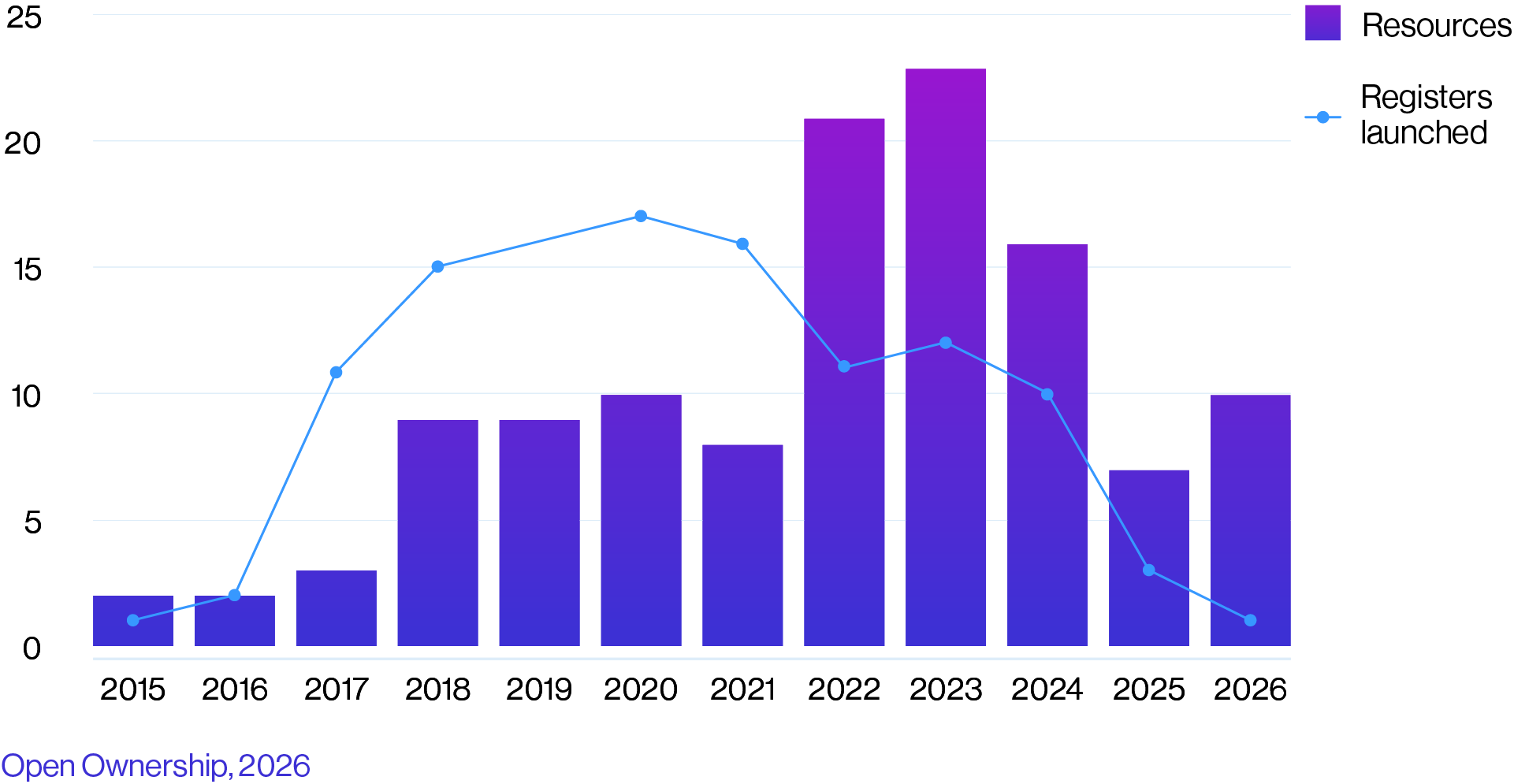
Resources in the BOT Evidence Centre by year of publication against year when BO registers were published internationally.
BO information serves a wide range of policy purposes, and limiting its use to fighting money laundering or organised crime underestimates its value. The Centre demonstrates this by including examples on topics such as a healthier business environment, natural resources, public procurement, real estate and property, and tax.
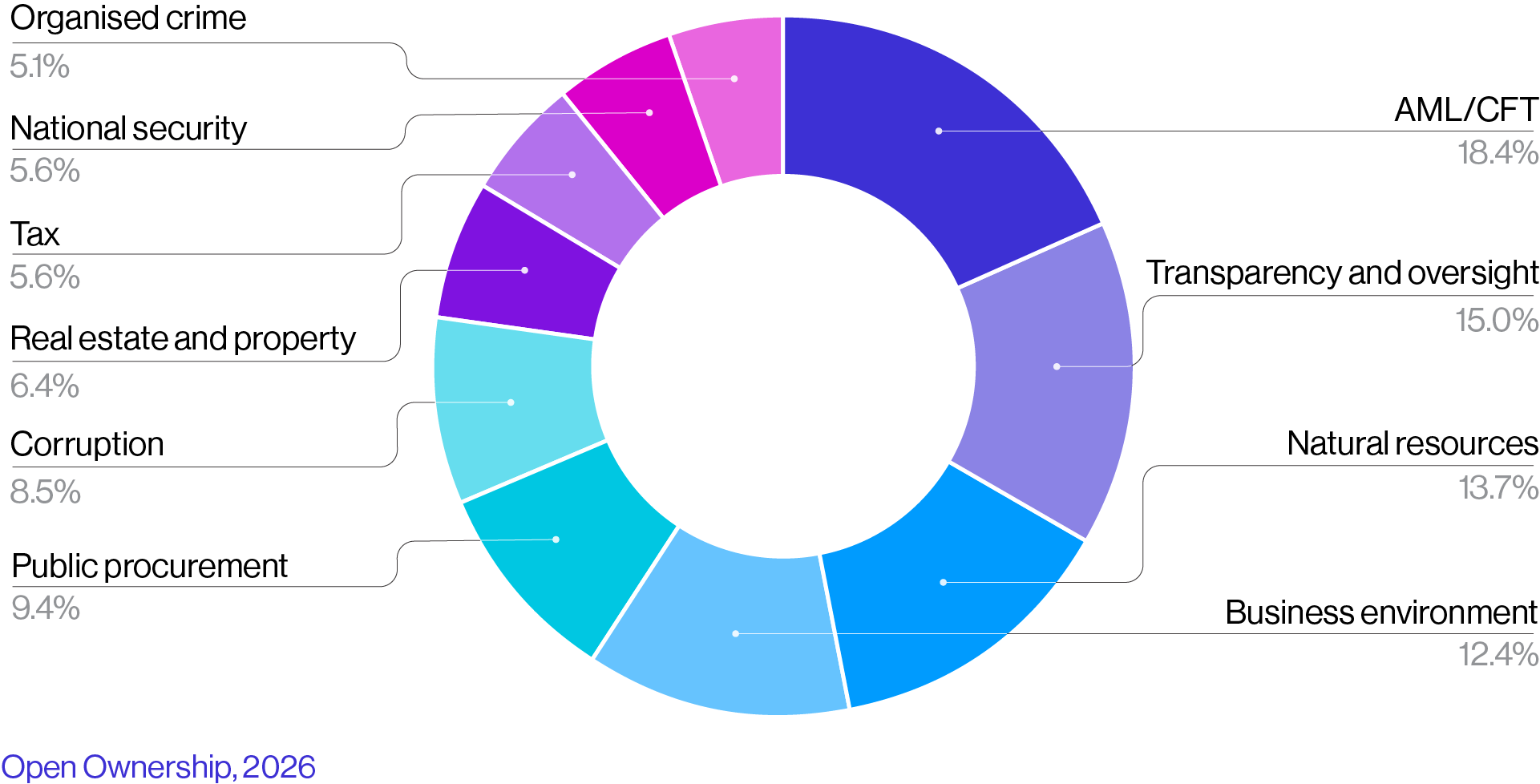
Resources in the BOT Evidence Centre categorised by topic.
Where BO data is not widely accessible, evidence of its use does not emerge. In other words, evidence follows access.
Although we made a particular effort to include resources from different parts of the world, the collection is concentrated in Europe (78 resources, around two thirds of the total) and, to a lesser extent, Africa (23 resources). This mainly reflects data availability. Until 2022, many European countries provided public access to BO information, and in Africa, countries with public registers, such as Ghana, Nigeria, and Zambia, account for most of the resources. The limited evidence from regions such as Latin America and the Caribbean points to the same conclusion from the opposite direction: where BO data is not widely accessible, evidence of its use does not emerge. In other words, evidence follows access.
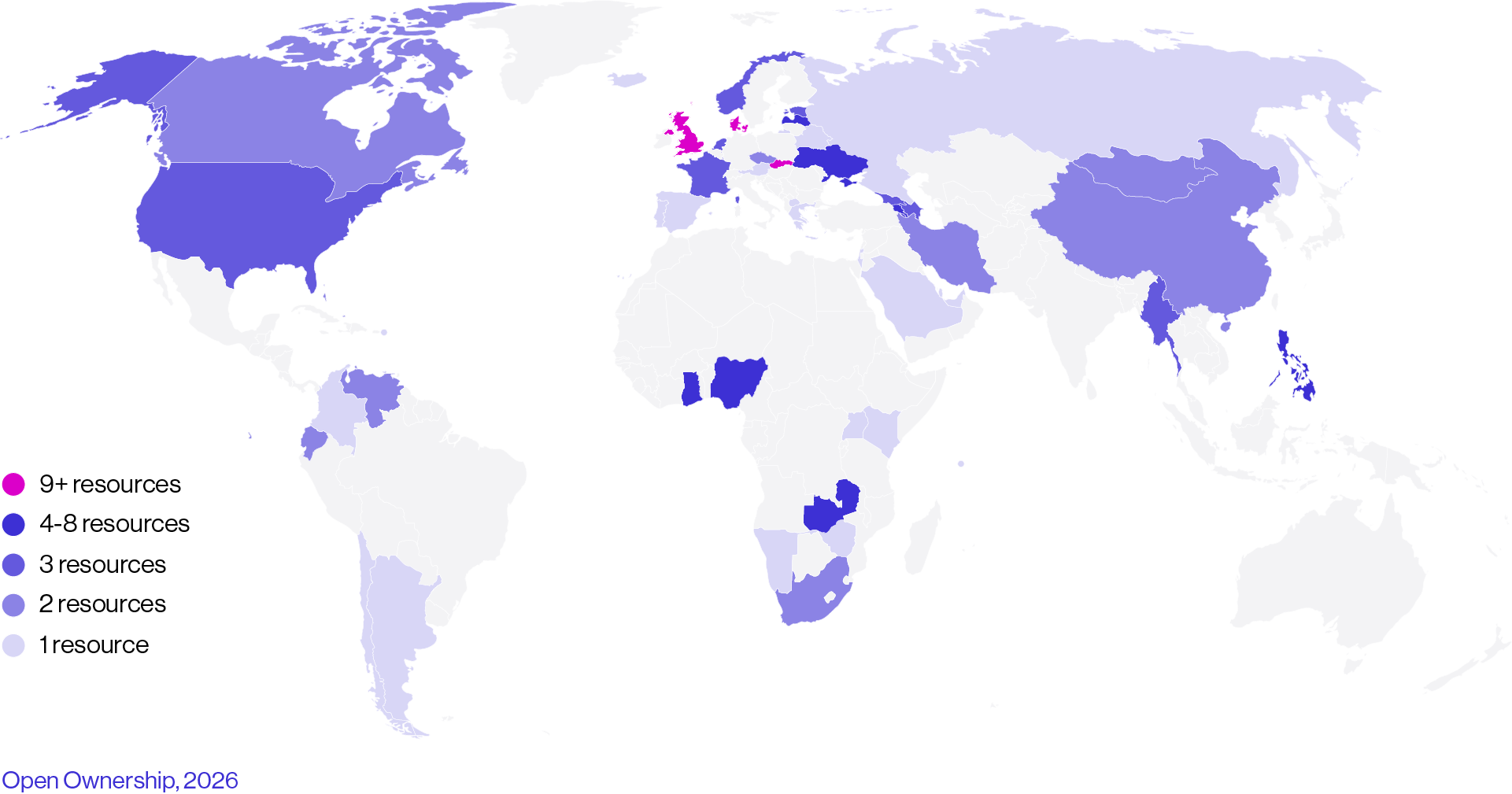
Number of resources in the BOT Evidence Centre categorised by jurisdiction.
The UK’s public BO register stands out in particular, with 36 resources (30% of the total) linked in some way to its data at the moment of launch. This reflects the register being public since 2016. Its data is well structured, free, and available for bulk download, and it is grounded in a broad policy rationale. The UK justifies its BOT policy on the argument that BO information strengthens the overall business environment, promoting competitiveness, accountability, and transparency. This framing supports broad access and, as a result, wider use. Many resources in the Evidence Centre using UK data are also indicative of the international nature of illicit financial flows, as they often involve corporate networks spanning several jurisdictions.
So far, public BO registers for legal vehicles have been the most influential overall in helping produce evidence.
What it takes to drive impact
Launching the BOT Evidence Centre has shown us that there is plenty of evidence demonstrating that BOT reforms matter for a range of policy outcomes. The patterns observed also speak to how implementation decisions affect impact. For instance, taking a broad approach when legislating for BOT is important: it supports the widest modes of access, which is a precondition for effective use.
The impact of a policy reform like BOT can in principle be measured without a researcher having direct access to the data. Qualitative research can seek to understand the experiences of targeted beneficiaries for example, and researchers in areas like tax often look at the effect of a policy being introduced or implemented without having direct access to personal information.
However, so far public BO registers for legal vehicles have been the most influential overall in helping produce evidence. As launch event panelist Dr Carol Seregni noted of academic research: “In order to provide empirical evidence that is supported by the data, we need the data itself… all the reforms and back and forth in terms of providing accessibility [and] then removing accessibility has led to [there being] incomplete data that we can use [for research].” Well-implemented legitimate interest access regimes could also produce such effects in theory, but they have not yet delivered in practice.
In the future, we also hope to see more evidence from government agencies that rely on detailed internal knowledge of data, especially where that is based on its proactive use for things like investigations or improving integrity in public procurement. Technical solutions such as the use of application programming interfaces (APIs) and automated risk flagging using bulk data can make government data use more effective. As noted by launch panellist Changcit Jagaba of the Nigerian Financial Intelligence Unit: “We have direct API-to-API connection between the Financial Intelligence Unit and the Corporate Affairs Commission, so with a click of a button you can get the data you are looking for, and it makes it so much easier.”
Impact measurement, especially when conducted by the public sector, is both an important accountability mechanism to citizens and a way to influence behaviour. As noted by launch panellist Dr Juan Cristóbal Moreno Crossley of ChileCompra: “We know that transmitting [risk] alerts isn’t enough to change behaviours, that is why we are committed to actively disseminating both statistics and case examples of the results of our work. […] We publish statistical data and feature a monthly story about a significant case that resulted in sanctions or another relevant outcome.”
Finally, the creation of impact and evidence should be understood as a continuum, with complementary roles for all users of BO information. Launch panellist Alexandra Gillies of the Organized Crime and Corruption Reporting Project noted this in her remarks, saying: “We are all aware that a lot of the regulators and law enforcement bodies in this field are severely under-resourced and they struggle to work across borders, so they rely on the work of investigative journalists to know where wrongdoing is happening. These are all mutually beneficial interventions.”
Impact measurement, especially when conducted by the public sector, is both an important accountability mechanism to citizens and a way to influence behaviour.
Collective action to measure evidence
By bringing together the evidence that already exists openly and in a single platform, we hope to encourage more people to engage with this topic, to attract more interest and funding for knowledge production, and to diversify the community working in this specialised field. Growing the evidence base for BOT can only be effective if it is a collaborative effort, and we invite our community to use the BOT Evidence Centre as a way to engage in this by using its contents and sharing the centre, submitting new entries, and creating new evidence through investigative and empirical work.
Get in touch with your feedback and suggestions for new entries at [email protected].