Protecting public money: How beneficial ownership transparency is changing procurement
Why procurement matters
Governments spend roughly USD 13 trillion every year on public procurement, paying for hospitals, schools, roads, and the day-to-day functioning of the state. The complexity of procurement processes, the sums involved, and the fragmented nature of supply chains expose governments to risks including corruption, fraud, conflicts of interest, and collusion. Knowing the beneficial owners – the real, human owners of corporate vehicles bidding for public contracts – is critical to identifying and mitigating these risks.
Reform is happening – and beneficial ownership data is at the heart of it
To address these risks, governments around the world are now building beneficial ownership checks into how they buy goods and services. Open Ownership has helped drive several of these reforms:
- In Kenya, following Open Ownership’s close collaboration with the government, the Public Procurement Regulatory Authority now has access to beneficial ownership data held by the Business Registration Service. The PPRA is exploring how to leverage BO information to strengthen procurement oversight.
- In the Philippines, Open Ownership’s technical assistance contributed to the beneficial ownership provisions in the New Government Procurement Act of 2024 and the procurement register that went live on the PhilGEPS government e-procurement system in late 2025.
- In Zambia, following Open Ownership’s engagement, the Treasury now requires certified beneficial ownership information from every bidder for public contracts.
At a global level, these reforms deliver on a growing international mandate. The Financial Action Task Force requires that procurement authorities are able to access beneficial ownership data in a timely way. Meanwhile, Resolution 10/6 of the United Nations Convention against Corruption (UNCAC) urges States Parties to take measures to facilitate access to beneficial ownership information by domestic public procurement authorities. Open Ownership advocated for this resolution during negotiations at CoSP10 in 2023.
How Open Ownership supports countries to improve public procurement
Open Ownership aims to give governments the evidence that beneficial ownership data works in procurement, as well as the methods to measure it and connections to learn from other governments.
Generating evidence: In 2023, Chile changed its procurement law to require every bidder to disclose its beneficial owners. ChileCompra, the national procurement agency, built the requirement into a live system handling approximately USD 16 billion a year, equivalent to roughly 5% of the country’s GDP.
Beneficial ownership disclosure became a condition of doing business on Mercado Público, Chile’s procurement platform. Within three months, 59% of the 66,000 targeted companies complied, resulting in the registration of over 100,000 beneficial owners.
Between December 2022 and February 2025, monthly conflict-of-interest cases detected by ChileCompra’s Observatory (its internal unit tasked with monitoring public spending to detect irregularities and promote integrity) dropped by 69%, from an average of 18.7 cases a month to 5.8. When bidders know the people behind their company are visible, fewer try to game the system.
Monthly detected cases of conflicts-of-interest before and after public procurement reform
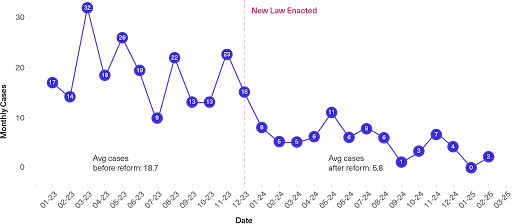
Source: The Observatory of ChileCompra.
Open Ownership documented how Chile’s system works, including the design choices, analytics, and early results. In partnership with ChileCompra and the Open Contracting Partnership, Open Ownership published a case study in 2025, creating an evidence base for reformers elsewhere to draw upon.
Measuring impact: Most countries with beneficial ownership requirements in procurement still cannot say with confidence what results these have produced. Alongside the Chile case study, Open Ownership published a starter guide in 2026 setting out concrete methodologies to measure the impact of beneficial ownership data use in mitigating fraud and collusion. Supported by the Beneficial Ownership Transparency Evidence and Measurement (BEAM) Programme, Open Ownership is working with the Philippines’ Department of Education to carry out beneficial ownership data checks during supplier screening and procurement decision-making.
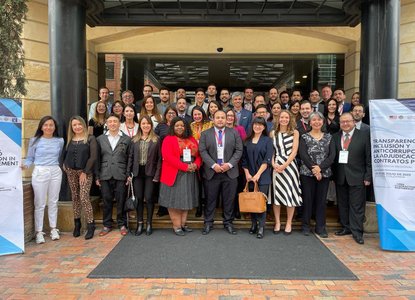
Building capacity: As part of its engagement and support, Open Ownership has co-delivered national and regional workshops with the United Nations Office on Drugs and Crime, Open Contracting Partnership and national partners in Southern and Eastern Africa, Latin America and Southeast Asia. These sessions aimed to drive greater transparency in procurement and demonstrate the value of linking beneficial ownership and procurement data. By showcasing best practices from other country contexts and connecting national authorities to learn practical approaches from one another, Open Ownership is supporting jurisdictions to scale what works.
What’s next
The next phase of work is about connecting government agencies and databases to deliver impact. Most beneficial-ownership-in-procurement systems still treat the bidder’s ownership as a one-off declaration, and the data itself may not be actively used to inform procurement decisions. The value of the data multiplies when beneficial ownership registers are connected directly with procurement systems, so that risk-flagging can be automated rather than relying on manual review. Open Ownership will support countries to build these connections – and to measure the difference they make to the integrity and effectiveness of public procurement.
Find out more about why using beneficial ownership information in procurement is one of two flagship focus areas in Open Ownership’s 2025–2030 strategy
Related articles and publications
-

Beneficial ownership transparency: Transforming public procurement in South Africa
Published: 23 February 2021
Publication type
Blog post
Topics
Procurement,
United Nations Convention against Corruption (UNCAC)
Sections
Impact